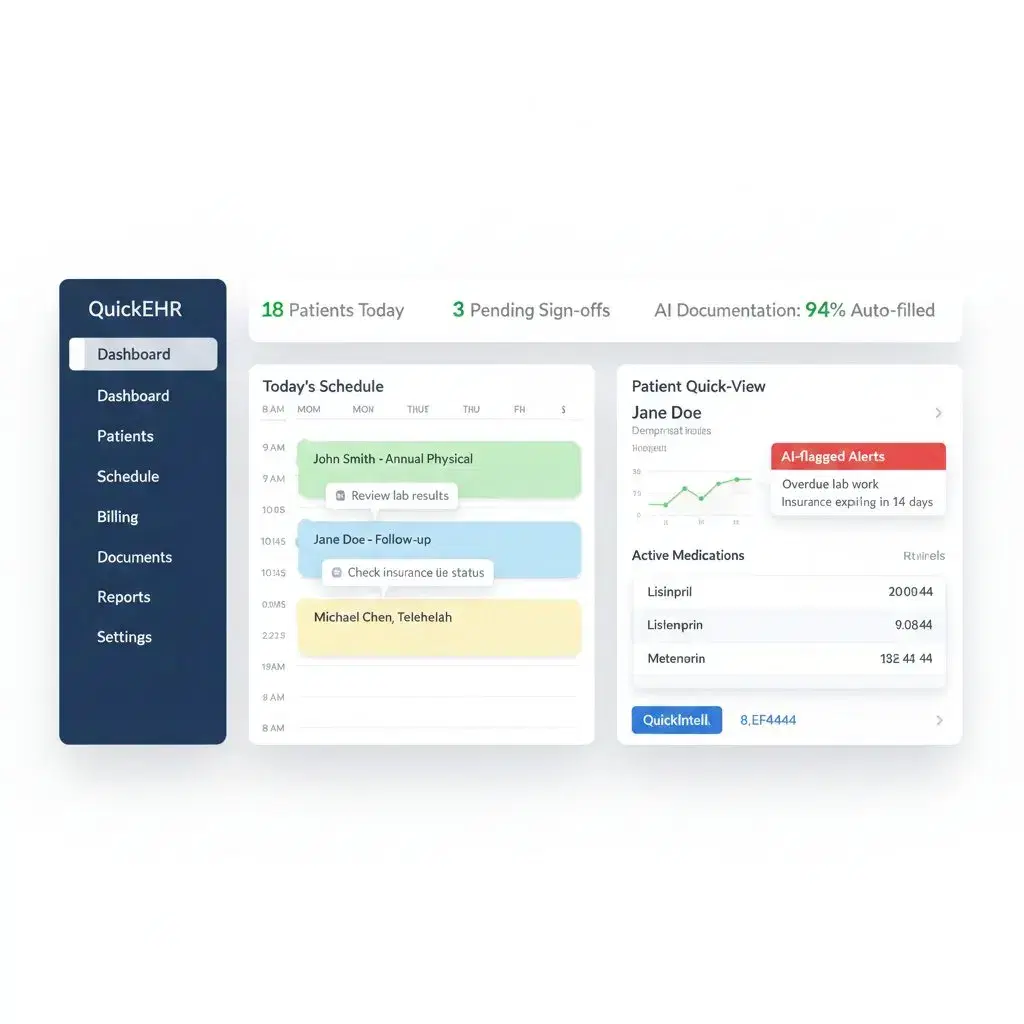
Checklist status, room readiness, AI handoffs, and revenue follow-through
Ready
Intake, forms, eligibility
Roomed
Vitals, meds, history
Handoff
Notes, auth, claims
Patient rooming workflow
Make every rooming step visible, owned, and connected to the chart.
Search intent for patient rooming spans definition, checklist, and rooming software evaluation. QuickEHR answers all three by connecting the patient rooming process to OpenEMR-powered chart context, staff queues, AI preparation, and revenue-cycle follow-through.
Before arrival
Prepare the rooming task before the patient is called
QuickEHR patient rooming starts with schedule, intake, forms, consent, eligibility, and visit-reason context so the team can see what needs attention before the patient reaches the exam room.
Use appointment type, provider, location, visit reason, intake status, and open tasks to prepare the rooming workflow.
Surface missing demographics, coverage questions, consents, documents, or preparation instructions for staff review.
Keep readiness signals tied to the patient, appointment, encounter, and team queue instead of scattered notes.
During rooming
Capture clinical intake without losing operational context
The patient rooming process usually includes identity confirmation, chief complaint, vitals, history updates, medication reconciliation, allergies, screenings, and exam-room status.
Structure rooming a patient around vitals, medication updates, allergy review, history changes, and reason for visit.
Make nurse rooming workflow, medical assistant tasks, room status, and provider readiness visible to the care team.
Carry unresolved questions into the right clinical, front-desk, or billing queue with clear review ownership.
Provider handoff
Turn rooming into a clean handoff for documentation and revenue work
Patient rooming software should not stop at a room status board. QuickEHR keeps rooming details close to documentation, coding, prior authorization, claims, remittance, and follow-up workflows.
Move reviewed rooming context into QuickScribe, clinical documentation, orders, and encounter completion workflows.
Use completed note, diagnosis, procedure, payer, and authorization context for QuickCode, QuickAuth, and QuickRCM preparation.
Connect post-visit follow-up, claim exceptions, payment questions, and ERA context when the encounter moves downstream.
Rooming checklist
Rooming patients is clinical intake plus operational handoff.
Medical rooming software should support more than a status board. QuickEHR keeps rooming patients, clinic rooming workflow, nurse rooming workflow, and exam room workflow close to the patient chart and the staff member responsible for the next action.
Review medication reconciliation, allergies, social history, family history, and health-history updates as configured by the practice.
Screenings and forms
Bring rooming patient checklist items, consent forms, assessments, questionnaires, and missing signatures into the encounter context.
Room and provider readiness
Show exam-room status, provider handoff, overdue rooming tasks, pending messages, and next-action ownership.
Billing-sensitive cues
Keep eligibility, prior authorization, referral, payer, procedure, and documentation cues visible before they become claim issues.
AI EHR patient rooming
QuickIntell automation prepares rooming work for review.
Patient rooming automation should reduce reconstruction, not remove judgment. QuickEHR uses QuickIntell modules to draft, classify, summarize, route, and prepare work across documentation, coding, authorization, RCM, and ERA workflows.
OpenEMR patient rooming works best when the chart and task queue stay connected.
QuickEHR is built on the OpenEMR foundation and adds managed workflow design around rooming tasks, chart context, documentation handoff, QuickIntell AI preparation, and post-visit revenue work.
QuickEHR-managed OpenEMR rooming
QuickEHR is built on the OpenEMR foundation and adds managed workflow design around chart, schedule, encounter, forms, portal, and billing context.
Existing OpenEMR tenants
Practices already using OpenEMR can evaluate approved OpenEMR API, FHIR, HL7, or interface-engine paths for rooming, intake, chart, and task data.
QuickEHR Connect for mixed systems
Clinics keeping another EHR or practice management system can scope QuickEHR as a workflow layer around access, encounter, claim, and remittance context.
Build patient rooming from the workflows around the visit.
Use these related QuickEHR pages to connect rooming with scheduling, patient flow, check-in, portal work, documentation, eligibility, and OpenEMR integration planning.
Launch rooming with checklist ownership, interfaces, and review rules defined first.
Patient rooming crosses front desk, medical assistant, nurse, provider, coding, authorization, billing, and patient support work. QuickIntell scopes implementation around role ownership, interface availability, AI review boundaries, data handling, and support ownership.
Review current security, privacy, access, and procurement materials in the QuickIntell Trust Center alongside the deployment packet for your specific implementation.
Rooming implementation checklist
Choose QuickEHR-managed OpenEMR, an existing OpenEMR tenant, or QuickEHR Connect for another EHR or practice management system.
Map the clinic rooming workflow from appointment readiness through patient call-in, identity confirmation, vitals, chief complaint, history updates, med reconciliation, exam-room status, provider handoff, checkout, and follow-up.
Define role ownership for front desk, medical assistants, nurses, providers, coders, authorization staff, billing teams, and support queues.
Confirm enabled OpenEMR API, FHIR, HL7, interface-engine, portal, communication, payer, clearinghouse, and revenue-cycle data paths.
Decide which AI actions may draft, classify, summarize, route, or prepare rooming work before staff, clinician, coding, authorization, or billing review.
Review access controls, audit expectations, patient-facing language, escalation paths, implementation evidence, and current Trust Center materials before production use.
Clinical review boundaries
AI can prepare and summarize rooming context, but the practice should define which clinical updates, patient-facing instructions, and provider handoffs require human review.
Deployment-specific interfaces
Available read, write, sync, portal, payer, payment, and clearinghouse paths depend on the deployed EHR environment and approved interfaces.
Workflow evidence
Use implementation artifacts to document rooming statuses, task owners, escalation paths, queue rules, and AI review points for the specific rollout.
Trust documentation
Review current security, privacy, access, and procurement materials in the QuickIntell Trust Center with the implementation packet for the deployment.
Specialty fit
Rooming needs vary by specialty, but the handoff problem is shared.
QuickEHR patient rooming can be scoped around specialty intake, screenings, vitals, measurements, documentation templates, authorization needs, and billing-sensitive encounter details.
Answers for teams comparing patient rooming software, OpenEMR patient rooming, rooming patient checklist workflows, AI EHR patient rooming, and QuickIntell implementation scope.
What is QuickEHR patient rooming software?
QuickEHR patient rooming software helps clinics organize patient intake, rooming tasks, vitals, history updates, medication reconciliation, exam-room status, provider handoff, documentation readiness, and downstream QuickIntell AI workflows around an OpenEMR-powered EHR foundation.
What does patient rooming mean in a clinic?
Patient rooming is the workflow of moving a patient from arrival into the exam-room portion of the visit. It usually includes identity confirmation, chief complaint or visit reason, vitals, medication and allergy review, history updates, screenings, preparation for the provider, and handoff.
How does QuickEHR support the patient rooming process?
QuickEHR can keep appointment context, intake status, forms, rooming checklist items, chart updates, room status, unresolved questions, and follow-up tasks connected to the patient, encounter, and team queue. Final scope depends on the deployment and enabled interfaces.
Can QuickEHR support a rooming patient checklist?
Yes. A rooming patient checklist can be configured around the clinic's workflow, such as identity, visit reason, vitals, medications, allergies, screenings, consents, forms, room readiness, provider handoff, and escalation rules.
How does AI EHR patient rooming work in QuickEHR?
AI EHR patient rooming in QuickEHR means assistive automation for drafting, summarizing, classifying, prioritizing, routing, and preparing rooming-related work for review. It does not replace required clinical, staff, coding, authorization, or billing review.
How does OpenEMR patient rooming fit with QuickEHR?
QuickEHR is built on the OpenEMR foundation. QuickEHR-managed OpenEMR deployments can plan rooming around managed chart, schedule, encounter, forms, portal, and billing context. Existing OpenEMR tenants can evaluate approved API, FHIR, HL7, or interface-engine paths.
Does patient rooming connect to QuickScribe, QuickCode, and QuickAuth?
Yes. Reviewed rooming context can help prepare QuickScribe documentation workflows, QuickCode coding review, and QuickAuth authorization packet preparation when those modules and data paths are configured for the practice.
How does patient rooming connect to QuickRCM and QuickERA?
Rooming can surface eligibility, payer, authorization, provider, location, documentation, and encounter details that affect claims and payment follow-through. QuickRCM and QuickERA can use that context for reviewable claim, denial, AR, remittance, and payment-posting workflows.
Can QuickEHR support self-rooming workflows?
Some practices may evaluate patient self rooming or lighter-touch check-in workflows. QuickEHR implementation should define which steps can be patient-facing, which require staff review, and how exceptions return to clinical or front-desk queues.
What should practices define before launching patient rooming?
Practices should define rooming stages, checklist items, role ownership, escalation paths, patient-facing language, AI assistance boundaries, interfaces, access controls, audit expectations, support ownership, and Trust Center evidence for the deployment.
Does this page make certification or compliance claims?
No. This page describes QuickEHR patient rooming workflow planning. QuickEHR is built on the OpenEMR foundation, and any certification, security, payer, procurement, legal, or regulatory evidence should be verified in the current implementation packet, contract, and QuickIntell Trust Center materials for the specific deployment.
See how QuickEHR can connect patient rooming to the rest of the visit.
Map intake, vitals, chart updates, provider handoff, documentation, coding, prior authorization, RCM, and ERA follow-through into one QuickIntell implementation plan.