Call
QuickEHR practice operations

Medical practice management software for QuickEHR and OpenEMR workflows

QuickIntell medical practice management software connects the work around every visit: scheduling, intake, eligibility, referrals, prior authorization readiness, documentation, coding, billing, claims, payments, denials, patient balances, and AI-assisted workflow automation.

Search intent: commercial PM software
Fit: EHR, billing, RCM, payments
Foundation: OpenEMR-powered QuickEHR

Practice management workspace

Schedule, intake, payer, chart, claim, payment

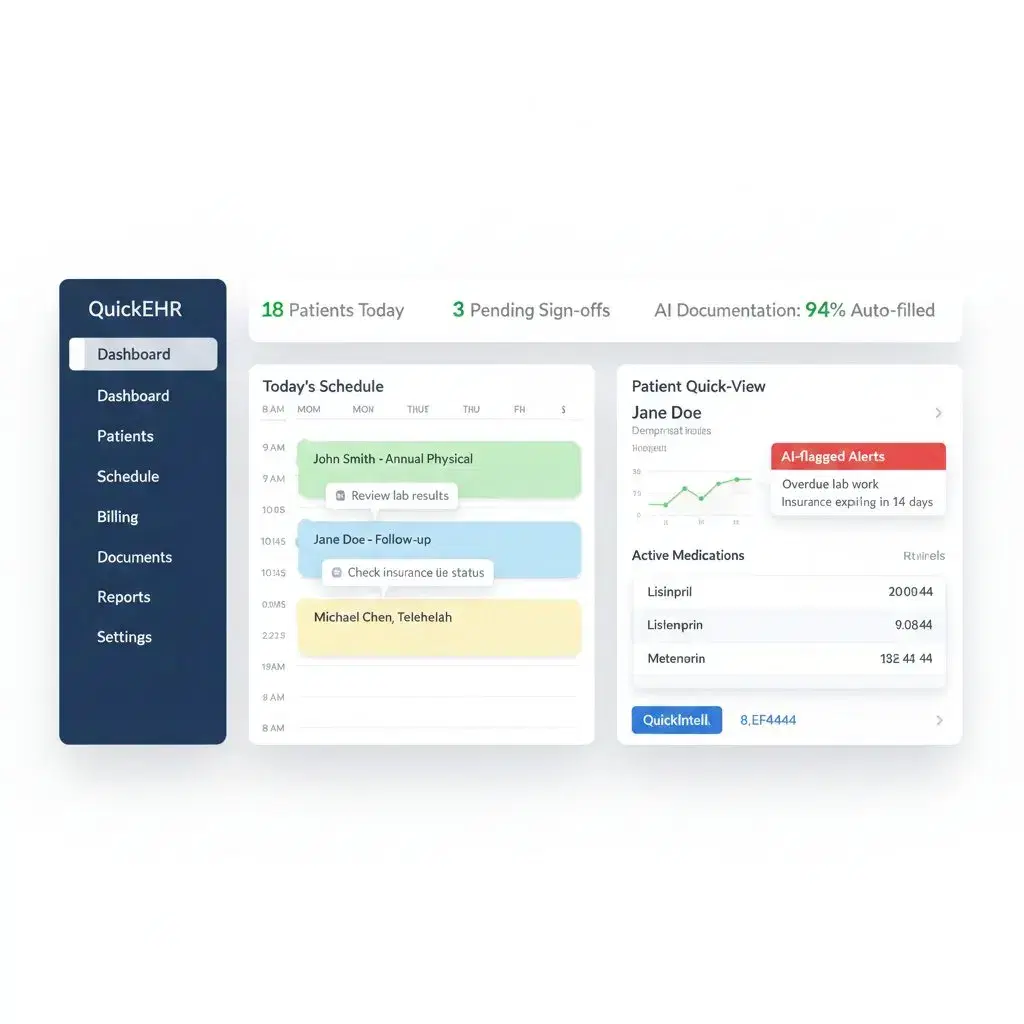
QuickEHR dashboard showing schedule, chart, billing, claims, and practice workflow context

Access

Schedule, intake, eligibility

Claim

Codes, charges, submit

Follow-up

ERA, denials, AR

Workflow

Connect the operating workflow from appointment to paid claim.

The medical practice management software SERP expects scheduling, registration, billing, claims, payments, denials, and reporting. QuickIntell adds QuickEHR and AI workflow automation around the clinical and payer context behind each task.

Patient access

Control the schedule and intake queue

Medical practice management software starts before the appointment. QuickEHR keeps visit type, provider, location, patient demographics, intake, reminders, portal tasks, and coverage readiness in one operating view.

  • Route scheduling changes, missing intake, duplicate demographics, and no-show follow-up into owned work queues.
  • Connect patient portal, patient messaging, reminders, self-scheduling, and patient registration to the visit record.
  • Keep front-desk work visible by provider, location, appointment status, payer, and missing information.

Visit readiness

Prepare each visit for documentation and billing

Practice management EHR software should not separate operational work from clinical context. QuickEHR connects the chart, payer rules, referrals, authorization evidence, coding questions, and charge readiness.

  • Use eligibility, referral, and prior authorization context before the patient arrives or the claim is released.
  • Carry QuickScribe documentation handoff and QuickCode review signals into charge and claim preparation.
  • Flag missing chart, payer, authorization, coding, or demographic details before they become avoidable rework.

Revenue cycle

Move clean work through claims and payments

Practice management billing software buyers expect the workflow to keep going after the visit. QuickEHR links billing, electronic claims, claim scrubbing, ERA/EOB review, payments, patient balances, denials, and AR follow-up.

  • Connect claim creation, claim edits, payer submission, corrected claims, denials, and owner queues to the source encounter.
  • Use QuickRCM for payer follow-up, denials, appeals, stalled AR, patient balances, and unresolved payment questions.
  • Use QuickERA context to tie ERA, EOB, adjustments, underpayments, and patient responsibility back to the claim.

Operations

Measure bottlenecks across the practice

The practice manager needs more than a claim list. QuickEHR supports reporting views across scheduling gaps, intake status, eligibility issues, authorization holds, coding holds, claim status, denials, AR aging, and payment exceptions.

  • Review operational work by provider, location, payer, specialty, owner, queue age, and status.
  • Use recurring denial, rejection, and payment patterns to improve scheduling, documentation, coding, and billing rules.
  • Keep implementation teams focused on workflows that reduce preventable handoffs and manual search time.

Specialty fit

One practice management layer, configured around each specialty workflow.

Advanced specialty practices need more than generic task lists. QuickEHR practice management can be scoped around the specialty rules that drive scheduling, intake, authorization, documentation, coding, claims, and payer follow-up.

Start with QuickEHR for the OpenEMR-powered foundation, then connect the specialty page that matches your clinic.

AI automation

Prepare work for review without hiding the source context.

For buyers comparing AI EHR practice management and EHR practice management software, QuickIntell focuses AI on classification, summaries, routing, and work preparation while preserving human review checkpoints.

Queue classification

Group scheduling, intake, eligibility, authorization, documentation, coding, claim, denial, payment, and patient balance work by reason and owner.

Visit readiness summaries

Prepare reviewable summaries of appointment, chart, payer, authorization, coding, charge, and patient communication context.

Handoff preparation

Draft structured handoffs between front desk, clinician, coder, biller, RCM specialist, and payment poster with review points intact.

Feedback loops

Use claim rejections, denials, payment exceptions, and AR patterns to tune intake, documentation, coding, billing, and payer rules.

OpenEMR and QuickEHR fit

Use OpenEMR-powered QuickEHR as the practice management foundation or workflow layer.

OpenEMR practice management searches often come from teams trying to connect scheduling, charting, billing, claims, and reporting. QuickEHR is built on the OpenEMR foundation and can be scoped with QuickIntell modules around the data paths available to the practice.

QuickEHR-managed OpenEMR foundation

QuickEHR is built on the OpenEMR foundation and adds QuickIntell workflow design around scheduling, patient access, chart context, billing, RCM, and ERA follow-through.

Existing OpenEMR environments

Practices already using OpenEMR can evaluate approved API, FHIR, HL7, EDI, clearinghouse, ERA, batch, or interface-engine paths for practice management data.

Connected EHR and PM systems

Groups keeping another EHR or practice management system can scope QuickEHR Connect and QuickIntell automation around the interfaces available for the deployment.

Related QuickIntell products

Practice management depends on the chart, coding, authorization, RCM, and remittance loop.

The page links below keep the buyer path connected across QuickEHR, QuickScribe, QuickCode, QuickAuth, QuickRCM, QuickERA, OpenEMR, and related QuickEHR practice management workflows.

Implementation and trust

Scope practice management around data paths, review roles, and operational ownership.

QuickIntell does not treat practice management as a single toggle. The launch plan should define what QuickEHR owns, what the source EHR or PM system owns, where QuickIntell AI can prepare work, and where staff review remains required.

Practice manager ready

Define queue owners, reports, escalation paths, and implementation sign-off.

Evidence scoped

Validate payer, claim, remittance, interface, and trust evidence for the deployment.

Implementation checklist

  • Choose whether QuickEHR is the managed OpenEMR-powered EHR, the workflow layer around an existing OpenEMR tenant, or a connected layer around another EHR or practice management system.
  • Map appointment types, provider calendars, locations, intake forms, portal workflows, patient reminders, eligibility checks, referrals, and authorization requirements.
  • Define review points for documentation, coding, charges, claim scrubbing, electronic claims, payment posting, denials, AR follow-up, patient balances, and reporting.
  • Confirm approved API, FHIR, HL7, EDI, clearinghouse, remittance, batch, file, or interface-engine paths before committing workflow scope.
  • Document which AI outputs can classify, summarize, draft, route, or prepare work and which steps require staff, clinician, coder, biller, or RCM review.
  • Review user roles, access controls, audit expectations, support ownership, trust documentation, procurement evidence, and production sign-off with the implementation team.

FAQs

Medical practice management software questions

These answers address common evaluation questions around QuickEHR, OpenEMR, AI workflow automation, EHR fit, billing, claims, and specialty practice operations.

What is medical practice management software?+

Medical practice management software helps healthcare practices manage scheduling, registration, intake, eligibility, referrals, prior authorization readiness, billing, claims, payments, denials, AR follow-up, patient balances, patient communications, and operational reporting. QuickIntell connects those workflows through QuickEHR, OpenEMR-powered context, and QuickIntell AI workflow automation.

How is practice management software different from an EHR?+

An EHR focuses on clinical records, charting, orders, results, and care documentation. Practice management software focuses on the business and administrative workflow around the visit, including scheduling, insurance, billing, claims, payments, denials, and reporting. QuickEHR is designed to keep those clinical and operational workflows connected.

Does QuickIntell support practice management billing software workflows?+

Yes. QuickEHR can connect billing workflows such as charge review, claim scrubbing, electronic claims, claim status, payment posting, ERA/EOB review, denials, AR follow-up, patient balances, and reporting. QuickRCM and QuickERA add deeper revenue cycle and remittance workflow support.

How does OpenEMR practice management fit with QuickEHR?+

QuickEHR is built on the OpenEMR foundation. A deployment can use QuickEHR-managed OpenEMR workflows or evaluate an existing OpenEMR environment when approved API, FHIR, HL7, EDI, clearinghouse, remittance, batch, or interface-engine paths are available.

Can QuickIntell help with AI EHR practice management?+

QuickIntell AI can help classify, summarize, route, and prepare work across scheduling, intake, eligibility, prior authorization, documentation, coding, billing, denials, payments, and patient follow-up. The implementation should define human review checkpoints for each workflow.

Can QuickEHR work with another EHR or practice management system?+

Practices keeping another EHR or practice management system can evaluate QuickEHR Connect and QuickIntell workflow automation around approved interfaces. Availability depends on the source system, enabled APIs or feeds, security review, roles, data quality, and implementation scope.

Which specialties can use QuickEHR practice management workflows?+

QuickEHR practice management workflows can be scoped for primary care, family medicine, internal medicine, urgent care, behavioral health, cardiology, orthopedics, pediatrics, OB-GYN, dermatology, gastroenterology, neurology, urology, pulmonology, and other ambulatory specialties when the required workflow and interface scope is available.

What should a clinic review before implementation?+

Review scheduling rules, intake forms, payer routing, eligibility workflows, authorization evidence, documentation and coding handoffs, charge sources, claim edits, ERA/EOB handling, patient balance rules, reporting needs, user roles, access controls, support ownership, and AI review checkpoints.

Practice management

Plan the workflow before software becomes another work queue.

QuickIntell helps scope the medical practice management workflow across QuickEHR, OpenEMR, AI documentation, coding, authorization, claims, RCM, ERA, and patient follow-up.