Current clean claims
15,840
88% of submitted claims
Use this QuickEHR claim calculator to model annual claim volume, clean claim rate, denial exposure, billing rework cost, and the workflow opportunity for QuickIntell AI automation. It is built for OpenEMR-powered practice management and revenue cycle teams that want a practical baseline before implementation planning.
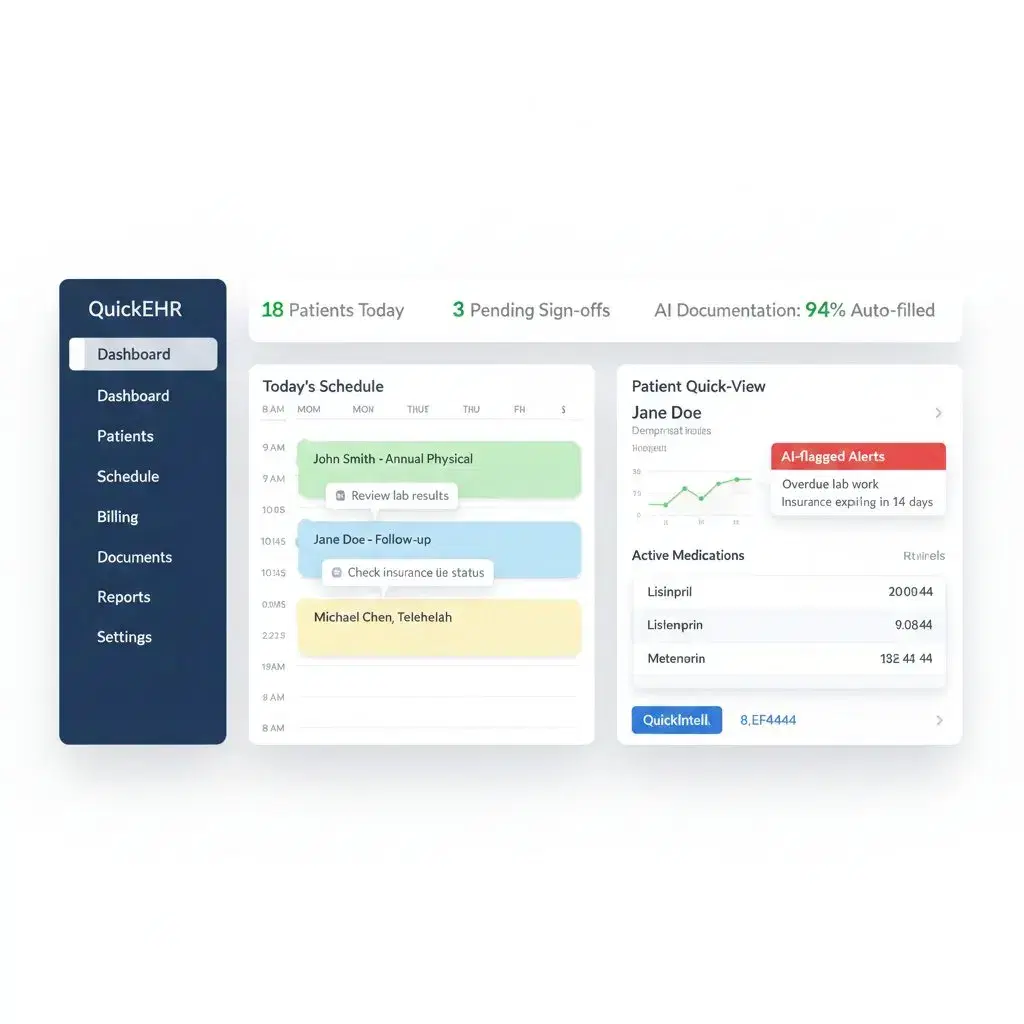
QuickEHR billing intelligence workspace
Claim baseline, scrubber checks, denials, ERA feedback
Model
Claims and denials
Improve
Scrubs and routes
Measure
ERA and AR signals
Interactive claim calculator
The calculator keeps the math visible so billing leaders can discuss assumptions before scoping QuickEHR, QuickRCM, QuickERA, and AI automation workflows.
QuickEHR claim calculator
Model denial exposure, clean claim rate, and rework cost.
Current clean claims
15,840
88% of submitted claims
Denied claims baseline
1,440
$266,400 in claim value routed to denial work
Annual rework hours
432
$16,416 estimated labor cost
Planning impact range
$70,704
Revenue protected plus billing labor recovered
360
fewer denied claims to work if the reduction assumption holds
108
billing hours that could move back to higher-value queues
1,260
additional clean claims needed to hit the target rate
This claim calculator is a planning model for workflow discovery. It does not guarantee payer reimbursement, denial reduction, compliance outcome, or implementation savings.
Annual claim count, service mix, payer mix, average claim value, and current billing throughput.
Clean claims divided by total claims submitted, with first-pass acceptance and rejection repair context.
Current denial rate, average claim value, preventable denial assumptions, and payer response patterns.
Minutes spent repairing rejected or denied claims, loaded team cost, and queue ownership by role.
Clean claim rate formula
A clean claim rate calculator is only useful when the team can explain what made a claim clean, rejected, denied, corrected, or resubmitted. QuickEHR keeps those statuses close to the encounter and payer response.
Formula
Clean claim rate = clean claims / total submitted claims x 100
Use the formula to create the baseline, then review why claims leave the clean path: missing eligibility data, coding questions, authorization gaps, documentation evidence, payer-specific edits, clearinghouse rejections, or denial patterns.
Workflow
Search intent around claim calculators is informational, but practice teams need operational next steps. QuickEHR ties the model to claim scrubbing, claims management, authorization, coding, denials, and remittance feedback.
Baseline
A useful medical billing claim calculator starts with a practical baseline instead of a generic savings claim.
Scrub
QuickEHR connects the claim calculator to the work that changes the metric: pre-submit review around the OpenEMR-powered encounter.
Route
Calculator results become operational when every source of claim drag has a queue, status, and owner.
Improve
The claim calculator should be revisited as payer responses, denials, ERA data, and AR work reveal new patterns.
AI EHR claim calculator
QuickIntell AI does not replace billing, coding, clinical, authorization, or payer decisions. It helps prepare context, classify exceptions, and connect the calculator baseline to the queues where staff can review and resolve work.
Summarize chart, payer, coding, authorization, and billing context so teams can understand what is driving claim rework.
Use QuickCode to prepare diagnosis, procedure, modifier, HCPCS, and HCC context for human validation before claim release.
Use QuickAuth status, payer requirements, approval windows, and packet notes to reduce avoidable authorization-related holds.
Feed claim status, denials, ERA/EOB exceptions, and AR follow-up back into the calculator assumptions and review workflow.
QuickEHR
Use QuickEHR as the patient chart, scheduling, claims, and practice management workspace behind the calculator.
QuickScribe
Prepare visit notes for clinician review so coding, authorization, and billing teams have better encounter evidence.
QuickCode
Bring ICD-10, CPT, HCPCS, modifier, and HCC context into coding review before claim release.
QuickAuth
Keep payer requirements, packet status, approval windows, and missing authorization work visible in claim review.
QuickRCM
Coordinate claims, denials, AR follow-up, eligibility gaps, and billing exceptions with encounter context in view.
QuickERA
Tie ERA/EOB data, posting exceptions, adjustments, and patient responsibility back to the original claim.
OpenEMR and QuickEHR fit
QuickEHR is built on the OpenEMR foundation. The claim calculator should be reviewed with the same patient, encounter, charge, claim, status, denial, and remittance data paths that will support production workflow.
QuickEHR is built on the OpenEMR foundation and adds QuickIntell-managed workflow configuration, AI preparation, implementation support, and integration planning around billing operations.
Practices already using OpenEMR can evaluate approved API, FHIR, HL7, clearinghouse, EDI, or interface-engine paths for encounter, claim, status, denial, and remittance context.
Teams keeping another EHR or practice management system can evaluate QuickEHR as a workflow layer when supported interfaces can provide the needed billing context.
Implementation and trust notes
The estimate should become a scoped operating plan: where the data comes from, which edits trigger review, who owns each queue, and how results will be measured after launch.
FAQs
Use these answers to align the calculator with clean claim rate, claim scrubbing software, OpenEMR, QuickEHR, and AI automation planning.
The QuickEHR claim calculator is a planning tool for estimating claim volume, clean claim rate, denial exposure, rework hours, and potential workflow impact from QuickIntell AI automation. It is designed for medical billing and practice management teams, not for estimating legal, VA, tax, or personal injury settlements.
Clean claim rate is commonly modeled as clean claims divided by total submitted claims, multiplied by 100. For example, if 8,800 of 10,000 submitted claims are accepted without avoidable errors or rework, the clean claim rate is 88%.
A medical claim calculator should include annual claims, average claim value, denial rate, clean claim rate, rework minutes, loaded team cost, and a conservative improvement assumption. More advanced reviews add payer mix, specialty, provider, location, claim status, denial code, and ERA/EOB context.
It is both. The page includes a claim calculator for baseline modeling, then connects the estimate to QuickEHR, QuickScribe, QuickCode, QuickAuth, QuickRCM, and QuickERA workflows that can help teams act on the sources of claim rework.
AI can help summarize claim exceptions, route work, prepare coding context for review, and surface denial patterns. The calculator uses an improvement assumption that should be validated against the practice's actual payer mix, workflows, integrations, and staff review points.
QuickEHR is built on the OpenEMR foundation. For QuickEHR-managed OpenEMR or an approved existing OpenEMR environment, QuickIntell can evaluate supported API, FHIR, HL7, clearinghouse, EDI, batch, or interface paths for claim and revenue cycle context.
No. The calculator is a discovery and planning model. It does not guarantee reimbursement, denial reduction, payer behavior, compliance outcome, or implementation savings. The estimate should be reviewed with actual claim data and scoped workflows.
Claim scrubbing software is one of the workflows that can improve calculator inputs. It checks claim data before submission, such as demographics, coverage, provider details, codes, modifiers, units, authorization evidence, documentation, payer rules, and clearinghouse requirements.
Prepare baseline metrics, payer routes, clearinghouse setup, claim edit policies, status feeds, denial codes, attachment workflows, ERA/EOB handling, user roles, integration requirements, and the review rules for AI-prepared suggestions.
QuickIntell can help translate clean claim rate, denial exposure, and rework cost into a scoped plan across QuickEHR, QuickCode, QuickAuth, QuickRCM, and QuickERA.