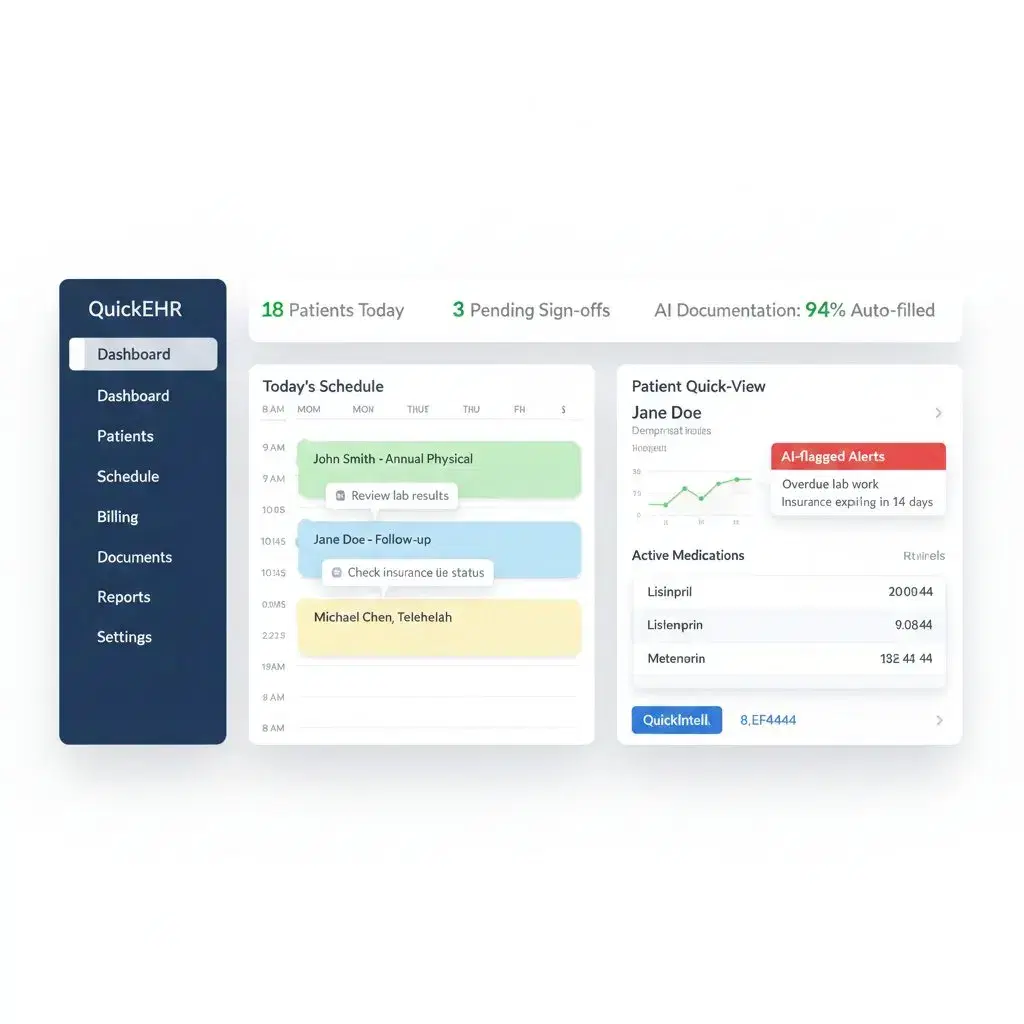
Medical invoicing software for QuickEHR billing workflows
QuickEHR medical invoicing software connects OpenEMR-powered charges, patient invoices, statements, payment requests, claim and remittance context, AI-assisted exception queues, QuickRCM, and QuickERA so patient balance work stays tied to the account story.
Healthcare invoicing software should keep every patient balance tied to its claim story.
The medical invoicing software SERP expects billing, practice management, patient payments, automation, and small-practice fit. In healthcare, that also means claim status, remittance, adjustments, denials, and the clinical or payer context behind each patient balance.
Before the invoice
Start with charge, claim, and patient responsibility context
QuickEHR medical invoicing software starts from the OpenEMR-powered encounter, charge, payer, claim, ERA, EOB, adjustment, and patient balance details that determine what can be invoiced.
Review patient demographics, guarantor, coverage, visit, provider, location, charge, coding, authorization, and claim status before a patient invoice is prepared.
Keep payer-paid, denied, adjusted, transferred, self-pay, copay, deductible, coinsurance, deposit, and prior-balance context visible in one workflow.
Route missing documentation, coding, authorization, eligibility, claim, payment posting, or patient account issues to the owner who can resolve the blocker.
Invoice creation
Prepare healthcare invoices and statements for review
Healthcare invoicing software should help practices prepare invoices, statements, receipts, and patient balance communications without disconnecting billing staff from the clinical and payer story.
Queue invoices by account, encounter, claim, payer response, balance type, patient responsibility, owner, and statement readiness.
Support reviewable patient statement, payment request, receipt, payment plan, refund, and balance follow-up workflows when configured for the deployment.
Separate clean patient billing from exceptions such as open claims, missing remittance, denied lines, unapplied payments, disputed balances, or pending adjustments.
After invoicing
Close the loop through payments, AR, and remittance
Medical billing invoicing software is strongest when payment posting, patient balances, denials, AR follow-up, and remittance review stay connected after an invoice is sent.
Connect card, portal, phone, in-person, mailed, or payment-plan activity to the QuickEHR account and the related claim or encounter.
Move payment exceptions, statement questions, unpaid balances, and payer issues into QuickRCM work queues with claim and account evidence attached.
Use QuickERA context to keep ERA, EOB, adjustment, underpayment, denial, and patient responsibility review tied to the invoice workflow.
Billing and patient account operations
From claim adjudication to patient invoice follow-up.
QuickEHR invoicing focuses on the healthcare account lifecycle, not generic invoice generation. Staff can review what produced the balance, what the payer did, what the patient owes, and what should happen next.
Charge and balance review
Review charges, payer-paid lines, adjustments, patient responsibility, prior balances, deposits, and account notes before invoice release.
Patient invoice preparation
Prepare patient invoices and statements from the encounter, claim, remittance, adjustment, and payment context in QuickEHR.
Keep open claims, denied lines, pending appeals, corrected claims, and payer status details visible before patient balances are advanced.
ERA and EOB handoff
Use QuickERA context to connect remittance, adjustments, transfers to patient responsibility, underpayments, and posting exceptions.
Refunds and unapplied payments
Route duplicate payments, credits, unapplied cash, takebacks, refunds, voids, and disputed items into review queues.
Small-practice billing controls
Support medical billing software for small practices with clear owner queues, simple review paths, and specialty-aware account context.
Practice management reporting
Track invoice status, statement readiness, payer versus patient balances, payment exceptions, aging, owners, and workflow bottlenecks.
AI medical billing software
AI should prepare invoicing work for review, not hide the billing decision.
QuickIntell AI can help summarize, classify, route, and prioritize invoicing work. The practice still defines review points for statements, payment requests, refunds, collections escalation, patient communication, and production approvals.
AI-assisted summaries can show the visit, claim, payer response, payment, adjustment, and patient responsibility context staff should review before invoicing.
Exception classification
Group accounts by missing remittance, denied lines, open claims, coding questions, authorization gaps, unapplied payments, refunds, disputed balances, or patient statement questions.
Patient balance task prep
Prepare reviewable task notes, balance explanations, payment follow-up checklists, and handoff prompts for billing teams without removing human approval.
RCM feedback loops
Use invoice questions, denial outcomes, remittance exceptions, and payment patterns to improve eligibility, documentation, coding, claims, and patient financial workflows.
OpenEMR and QuickEHR fit
OpenEMR invoicing works best when account context is mapped before automation starts.
QuickEHR is built on the OpenEMR foundation. The implementation path determines whether QuickIntell reads invoice context from a managed QuickEHR deployment, an existing OpenEMR tenant, or another system connected through QuickEHR workflows.
QuickEHR-managed OpenEMR
QuickEHR is built on the OpenEMR foundation and adds QuickIntell-managed workflow configuration, AI-assisted worklists, and billing operations around it.
Existing OpenEMR tenants
Practices already using OpenEMR can evaluate approved OpenEMR API, FHIR, HL7, EDI, clearinghouse, ERA, or interface-engine paths for patient account context.
QuickEHR Connect
Practices keeping another EHR or practice management system can evaluate QuickEHR as a workflow layer around documentation, coding, claims, remittance, invoicing, and AR.
Review the OpenEMR integration for QuickIntell workflow planning around OpenEMR software, QuickEHR, QuickScribe, QuickCode, QuickAuth, QuickRCM, QuickERA, and connected patient account data.
Connected QuickIntell products
Invoicing should connect to documentation, coding, authorization, RCM, and remittance.
Patient balance work is downstream from clinical and payer events. QuickEHR keeps the invoice workflow connected to the QuickIntell products that create or resolve billing context.
Launch invoicing only after balances, data paths, and review ownership are clear.
Medical invoicing touches patient communication, payments, payer adjudication, accounting handoff, and collections policy. QuickEHR implementation should define the boundaries before automation is enabled.
Use the QuickIntell Trust Center during procurement and implementation review for current trust, security, data handling, and support materials.
Patient invoices are one part of the revenue cycle.
Invoicing works better when claims, payment posting, denials, AR, and patient financial workflows are planned together. These pages cover the adjacent operating surfaces.
Answers for teams evaluating QuickEHR invoicing, OpenEMR invoicing, AI EHR invoicing, and patient balance workflows.
What is QuickEHR medical invoicing software?
QuickEHR medical invoicing software is the QuickIntell workflow for preparing and managing patient invoices, statements, payment requests, balances, receipts, payment plans, and invoice exceptions around OpenEMR-powered charge, claim, remittance, payment posting, QuickRCM, and QuickERA context.
How is medical invoicing software different from general invoicing software?
General invoicing software often focuses on creating an invoice and collecting payment. Medical invoicing software needs healthcare context: patient responsibility, payer adjudication, ERA and EOB details, claim status, denials, adjustments, coding context, authorization evidence, statements, payment posting, and AR follow-up.
Does QuickEHR support OpenEMR invoicing workflows?
QuickEHR is built on the OpenEMR foundation. Practices can use QuickEHR-managed OpenEMR workflows or connect an existing OpenEMR environment when approved API, FHIR, HL7, EDI, clearinghouse, ERA, or interface-engine paths are available for patient, encounter, claim, payment, and account context.
How does AI help with EHR invoicing?
QuickIntell AI can help classify invoice exceptions, summarize claim and payment history, prepare reviewable patient balance task notes, detect missing evidence, prioritize worklists, and route account blockers to billing, coding, authorization, eligibility, payment posting, or patient financial teams.
Can QuickEHR create invoices from claim and remittance context?
QuickEHR can support invoice and statement workflows around claim, ERA, EOB, adjustment, payment, and patient responsibility context when the required data paths are configured for the deployment. Billing teams should still review balances, patient communications, and production approvals.
Does QuickEHR replace a clearinghouse, payment processor, or accounting system?
Not by default. QuickEHR is the EHR and workflow layer around invoicing and patient balances. A practice may still use a clearinghouse, payer portal, payment processor, accounting system, lockbox, billing service, or collection partner depending on the implementation and contract model.
How do QuickCode, QuickAuth, QuickRCM, and QuickERA support invoicing?
QuickCode brings coding and charge context into review, QuickAuth keeps authorization evidence visible, QuickRCM organizes claims, denials, AR, and patient balance follow-up, and QuickERA ties ERA and EOB details to payment posting, adjustments, and patient responsibility.
Is QuickEHR invoicing useful for small practices?
It can be useful for small practices evaluating medical billing software for small practices because the workflow keeps account ownership, invoice readiness, patient balances, payment exceptions, denied balances, and follow-up tasks organized without forcing staff to rebuild the claim story manually.
What should a practice review before launching invoicing?
Review invoice sources, charge capture, claim status feeds, ERA and EOB inputs, adjustment rules, transfer-to-patient policies, statement timing, payment routes, refund policies, patient portal setup, access controls, AI review boundaries, support ownership, and current trust materials before go-live.
Does this page make compliance or certification claims?
No. This page describes QuickEHR invoicing workflow planning. QuickEHR is built on the OpenEMR foundation, and any regulatory, security, certification, payer, processor, or procurement evidence should be verified in the current implementation packet and contract for the specific deployment.
See how QuickEHR keeps invoices tied to the clinical and payer story.
Walk through patient invoice prep, account exceptions, payment handoff, QuickRCM queues, and QuickERA remittance context in a QuickEHR implementation discussion.