AI-Powered RCM and Clinical Documentation for Healthcare Providers
TL;DR
- Live in 2 weeks
- EHR-agnostic
- SOC 2 Type II
- BAA in 24 hours
Cut denial rates from 12% to 3%. Drop days-in-AR by 30%. Give clinicians two hours back per day. EHR-agnostic. SOC 2 Type II.
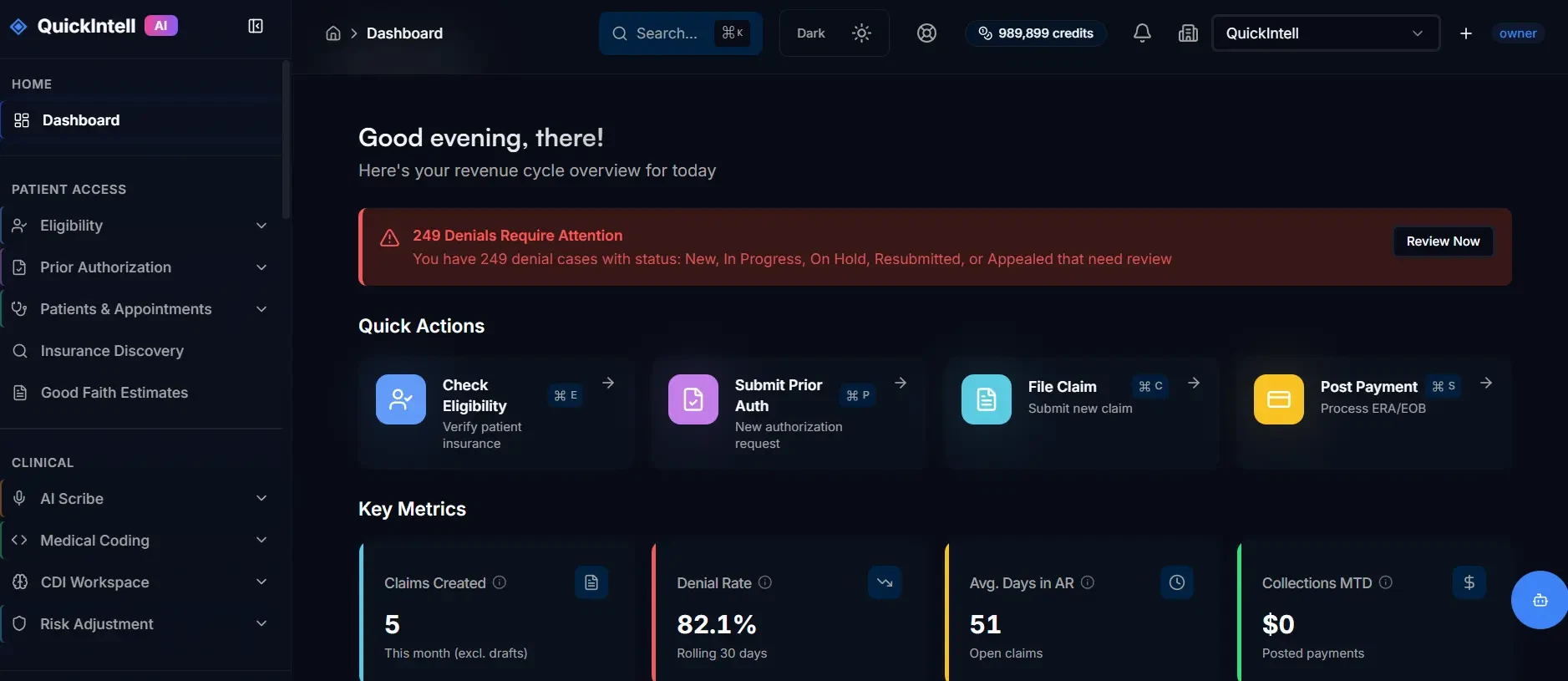

AI-Driven Solutions for Healthcare Providers
Discover how our cutting-edge AI technologies are transforming healthcare operations and improving patient outcomes.

AI RCM
Revolutionize Revenue Cycle Management with automated eligibility verification, prior authorizations, medical coding, claims processing, and denial management.

AI Classification
Intelligent document processing and categorization for efficient data extraction and reduced manual data entry.
AI Eligibility Verification
Automated real-time insurance eligibility checks to reduce claim denials and accelerate patient intake.

AI Scribe
Real-time clinical documentation that transforms patient-physician conversations into structured, high-quality clinical notes.

AI Voice Agents
Automated administrative tasks and patient interactions, including appointment scheduling and pre-authorization.
One platform, every step from schedule to settled
QuickRCM connects scheduling, eligibility, the encounter, AI Scribe, AI Coding, Denial Prevention, claim submission, ERA posting, and AR workflows on a single audit-ready timeline — replacing five to ten point tools.
- Step 01
Schedule
Appointment lands in QuickRCM from your EHR or scheduling tool and seeds the entire revenue cycle.
- Step 02
Eligibility
Nightly batch verifies coverage via Availity or Stedi and writes copays and deductibles back to the EHR.
- Step 03
Encounter
Clinician sees the patient with verified insurance and intake already complete on the front desk.
- Step 04
AI Scribe
Ambient SOAP note is drafted in real time, attested by the provider, and written back to the EHR.
- Step 05
AI Coding
QuickCode extracts ICD-10, CPT, and E/M codes, asks clarifications, and resolves NCCI and MUE findings.
- Step 06
Denial Prevention
Claim is scrubbed against payer-specific rules learned from past denials before it ever leaves the building.
- Step 07
Submit
Clean 837 is routed through Stedi or Availity to the payer with status tracked through 277 acknowledgments.
- Step 08
ERA Posting
835 remittances auto-post payments, route denials to triage, and surface underpayments against contract rates.
- Step 09
AR / Patient / Appeals
Aged claims hit AR Management, residual balances flow to Patient AR via Stripe, and denials drive appeals.
Pipeline automation is configurable at every step — start in NOTIFY_ONLY for the first 30 days, move to SEMI_AUTOMATIC by day 60, and run AUTOMATIC end-to-end once your team has built confidence.
Live in your EHR — not in a side portal
Bidirectional integrations live in your EHR in 2 weeks.
- Epic
- Cerner
- athena
- eClinicalWorks
- NextGen
- Availity
- Stedi
Unlock Operational Efficiency and Cost Savings
QuickIntell's AI-powered solutions help healthcare providers achieve unprecedented levels of efficiency and cost reduction.
Substantial Cost Savings
Reduce administrative costs by up to 72% through automation.
Reduced Denials
First-pass denial rates reduced from 12% to 3% with AI-powered claim accuracy.
Faster Cash Flow
Cut AR days by approximately 30% to accelerate reimbursement.
Enhanced Compliance
Ensure robust compliance with critical healthcare regulations.
Based on customer cohort observed over 12 months; results vary by specialty and prior baseline.
Transform Your Healthcare Operations Today
Join hundreds of healthcare providers who have already revolutionized their operations with QuickIntell's AI solutions.
Get a Free DemoFour workflows providers run every day on QuickIntell
Each workflow maps to a production module in QuickRCM with its own audit trail, role-based access, and EHR write-back.
Module 32
Charge Capture
Catch missed charges before they become silent leakage. Re-prices every encounter against the active payer contract and runs a weekly scan on closed encounters.
1.5%–3.0% of net revenue typically recovered within 90 days.
Module 07
Denial Prevention
An LLM-powered scrub between Coding and Submission. Scores every draft claim against your denial history and the payer profile, then surfaces fixable issues before the clearinghouse ever sees the claim.
Denial rates typically drop from 10–14% to 5–7% within 90 days.
Module 09
Patient AR + Stripe
Statements by mail, email, and SMS, payment plans with Stripe auto-charge, and a no-login pay portal. Aging refreshes nightly and balances write back to the EHR.
Self-pay collection moves from 50–60% to 75–80% on $200+ balances.
Module 30
Analytics & Reporting
Eighteen read-only dashboards that pull from every QuickRCM module. Filter by date, facility, payer, or provider, then click straight through to the source claim, encounter, or remittance line.
First-pass clean-claim rate typically lifts from ~80% to 88–90%.
Outcomes vary by specialty, payer mix, and prior baseline. See the QuickRCM training manual for the full module catalog and benchmarks.
Trusted by Healthcare Leaders

“QuickIntell's Medical Scribe has transformed how I handle patient records. It securely organizes patient data, allowing me to focus on care rather than paperwork.”
Dr. Emily Carter
Internal Medicine, Midwest Health Partners
Why Choose QuickIntell?
Discover the unique advantages that set QuickIntell apart in the healthcare AI landscape.
Human-like Agents
Our AI agents emulate human cognitive functions, automating routine tasks and freeing up staff for complex, patient-facing roles.
Unmatched Precision
Advanced NLP and CV ensure superior accuracy in extracting and interpreting complex healthcare data.
Scalable Intelligence
Our AI platform scales effortlessly to meet evolving healthcare needs and growing patient volumes.
Compliance & Security
Robust security protocols and HIPAA compliance ensure the safeguarding of patient health information.
Ready to Experience the QuickIntell Difference?
Join the healthcare revolution and discover how our AI-powered solutions can transform your operations, reduce costs, and improve patient care.
Real-World Results
Our AI-powered solutions have delivered significant results for healthcare providers, transforming operations and improving outcomes.
reduction in administrative costs
reduction in AR days
increase in revenue capture
denial rates reduced
Based on customer cohort observed over 12 months; results vary by specialty and prior baseline.
Join the Success Stories
These results aren't just numbers—they represent real healthcare organizations that have transformed their operations with QuickIntell.
Healthcare-grade trust, built into every workflow
Independent attestations and operational guarantees that compliance, revenue integrity, and IT teams require before AI touches PHI or claims.
HIPAA Compliant
Privacy and Security Rule controls applied across the platform, with encryption at rest and in transit.
SOC 2 Type II
Independently audited operating effectiveness of security, availability, and confidentiality controls.
HITRUST CSF
HITRUST CSF aligned controls for healthcare-grade risk management and information protection.
BAA in 24 hours
Signed Business Associate Agreement turned around within one business day so your team can move from evaluation to implementation without legal delays.
Daily OIG screening
Every payer, provider, and vendor record screened against the OIG List of Excluded Individuals/Entities each day to keep claims compliant and reimbursable.
Underpayment detection nightly
Nightly contract-rate reconciliation flags underpaid claims before timely-filing windows close, surfacing recoverable revenue every morning.
Frequently Asked Questions for Healthcare Providers
EHR integration, BAAs, pricing, MIPS, AR performance, charge capture, multi-specialty support, SOC 2/HITRUST, implementation, and multi-tenant deployments — straight answers for provider organizations and the RCM teams that serve them.
Related Solutions for Providers
Drill into the QuickIntell capabilities that providers most often deploy alongside core RCM.
AI RCM Automation
End-to-end revenue cycle automation across eligibility, coding, claims, and AR.
Explore AI RCM AutomationAutomated Prior Auth
Real-time prior authorization across payers with status tracking and appeals.
Explore Automated Prior AuthAI Medical Coding
Specialty-aware ICD-10, CPT, and HCC coding with auditable evidence chains.
Explore AI Medical CodingPerformance Coding
Coder productivity and accuracy lift with AI-assisted review queues.
Explore Performance CodingAI Voice Assistants
Voice agents for AR calling, eligibility, and patient outreach at scale.
Explore AI Voice AssistantsCDI Optimization
Clinical documentation integrity workflows that close gaps before billing.
Explore CDI OptimizationProvider Analytics
Operational, financial, and clinical KPIs unified across your practice.
Explore Provider AnalyticsPopulation Risk
HCC capture, risk adjustment, and care-gap surfacing for value-based care.
Explore Population RiskCare Coordination
Referral management, transitions of care, and longitudinal patient tracking.
Explore Care CoordinationACO Compliance
Quality measure tracking, attribution analytics, and ACO reporting workflows.
Explore ACO ComplianceHospitals & Health Systems
Inpatient billing, DRG validation, and enterprise RCM for hospitals.
Explore Hospitals & Health SystemsAmbulatory Surgery Centers
ASC-specific scheduling, implant tracking, and surgical claim workflows.
Explore Ambulatory Surgery CentersBehavioral Health
Behavioral and mental health billing with parity rules and authorization tracking.
Explore Behavioral HealthHome Health
OASIS-aware home health billing, visit verification, and PDGM optimization.
Explore Home HealthImaging & Radiology
Imaging-specific coding, prior auth, and modality utilization analytics.
Explore Imaging & RadiologyLabs & Pathology
Lab order intake, requisition coding, and pathology billing workflows.
Explore Labs & Pathology
Discover How QuickIntell Can Transform Your Healthcare Operations
Contact us today to schedule a personalized consultation and explore how our advanced AI agents can revolutionize your revenue cycle management, document classification, eligibility verification, clinical documentation, and administrative tasks.