AI voice agents for payor member-service calls
Handle identity verification, benefits and eligibility, claim status, prior auth status, escalation, transcripts, and write-back.
QuickVoice gives payor and member-service teams a HIPAA-aware AI telephony layer for approved call scripts, connected RCM data, human handoff, and auditable outcomes.

TL;DR
Proof-led QuickVoice coverage
These claims are limited to workflows and outcomes documented for QuickVoice and connected QuickRCM modules.
Supported workflows
Identity-verified member questions, benefits and eligibility, claim status, prior auth status, payment/balance support, opt-outs, and escalation.
Connected data
QuickVoice uses Eligibility, Claims, QuickAuth, Patient AR, Analytics, Reports, EHR/OpenEMR, Telnyx, Availity, and Stedi where configured.
Compliance controls
HIPAA minimum necessary, Strict HIPAA Mode, TCPA quiet hours, DNC, FDCPA controls where relevant, RBAC, audit logs, and encrypted recordings.
Measured outcomes
Track connect rate, call outcomes, abandonment, write-back success, opt-outs, cost per call, AR movement, and eligibility denial movement.
AI answers routine calls and routes out-of-scope issues to a human.
Manual-backed target for automated reminder campaigns.
When stale coverage is re-verified before service.
Manual-backed target when AI answers calls on the first ring.
How QuickVoice handles payor calls
Member-service workflows stay grounded in the knowledge base, connected RCM records, and configured escalation rules.
Verify identity before account-specific answers
Strict HIPAA Mode can require name and date-of-birth verification before the agent reads balances, appointment details, or other member-specific data.
Classify the caller intent
The knowledge base routes benefits, eligibility, claim status, prior auth status, billing, scheduling, clinical, complaint, and opt-out intents.
Use the connected source of truth
Eligibility, Claims, QuickAuth, Patient AR, and EHR/OpenEMR data support scripted answers or human routing when the request is outside configured policy.
Escalate low-confidence or sensitive calls
Clinical questions, complaints, unclear caller intent, low-confidence outcomes, and human requests can warm-transfer or land in Needs Review.
Capture transcript and outcome
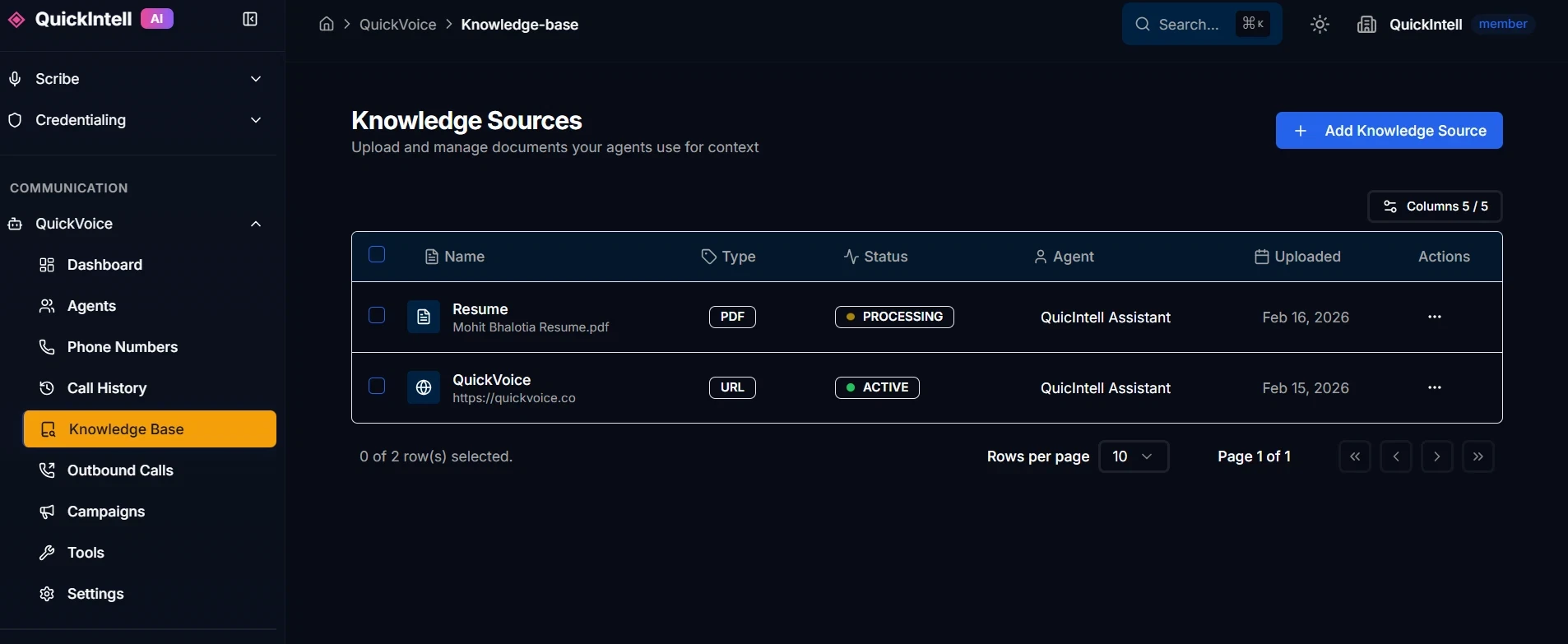
Call History stores the Telnyx call leg, recording player, transcript, intent timestamps, suggested outcome, confidence score, and reviewer notes.
Write back the result
Confirmed updates, new insurance, payment promises, DNC requests, appointment changes, and call notes write back to downstream QuickRCM modules and the EHR.
Integrations and data flow
QuickVoice is most useful when it is connected to the same operational systems that service teams already use. For a broader payor operating model, see QuickIntell for payors.

QuickVoice
AI telephony layer for inbound triage, outbound campaigns, knowledge bases, call history, transcripts, outcomes, and Telnyx-powered phone work.
Eligibility
Feeds active coverage, stale-check triggers, copay/deductible data, and new-insurance re-verification into member-service workflows.
Prior Auth
Surfaces authorization status, renewal needs, denial or appeal handoffs, and EHR write-back for status calls.
Claims
Provides claim status, clearinghouse routing, payer responses, and EHR claim-status notes for claims-related calls.
Patient AR
Supplies balances and payment-plan candidates; receives payment promises, plan outcomes, and account notes after verified calls.
Analytics and Reports
Receives connect, outcome, cost, opt-out, write-back, denial, AR, and campaign metrics for dashboards, exports, and scheduled reporting.
EHR/OpenEMR
Provides member demographics, phone, appointments, coverage, and chart context; receives call notes and approved operational updates.
Telnyx
Handles phone numbers, outbound calls, inbound binding, call legs, and telephony execution so teams do not manage carrier infrastructure.
Availity and Stedi
Supported clearinghouses for eligibility, claims, ERA, claim status, and prior auth routing where payer capability flags allow.
Analytics that close the loop
Every call should leave a measurable trail: what happened, whether it was safe to automate, where it wrote back, and what a human still needs to review.
Campaign and call performance
Monitor connect rate, completion rate, voicemail/no-answer patterns, opt-outs, cost, and outcomes by campaign or agent.
Revenue-cycle follow-through
Tie calls back to eligibility re-verification, payment promises, patient AR movement, claim status follow-up, and prior auth status work.
Review and audit queues
Filter Call History by patient, date, direction, agent, outcome, or Needs Review to inspect recordings and correct write-backs.
Security and compliance controls
QuickVoice call handling is designed around healthcare privacy, controlled outreach, and reviewable operational evidence. Learn more in the Trust Center.
HIPAA minimum necessary
Scripts can be limited to the minimum information needed for the call purpose, with Strict HIPAA Mode blocking account-specific details until verification.
DNC, TCPA, and FDCPA controls
Quiet hours, do-not-call requests, and collection-related contact limits are checked before or during outreach, including FDCPA controls where relevant.
RBAC, audit trail, and encrypted records
Role-based access governs call records, transcripts, exports, and operational actions; recordings and transcripts are protected by platform encryption controls.
Payor workflow tiles
These are non-redirecting workflow examples for teams evaluating member-service automation.
Benefits and eligibility questions
Answer approved coverage questions, confirm stale or partial coverage with the member, and trigger re-verification when new insurance is captured.
Claims status intake
Use connected claim-status data for scripted status responses, then route disputed, aged, denied, or unclear claims to a human work queue.
Prior auth status calls
Surface approved, in-review, pended, denied, partially approved, or expiring authorization states and hand off clinical or appeal questions.
Patient balance support
After identity verification, answer balance questions, capture payment promises, support payment-plan workflows, and write outcomes to Patient AR.
Reminder and re-verification outreach
Run outbound appointment reminders, recall, balance reminders, and T-2-day eligibility re-verification campaigns inside compliant call windows.
Human escalation and QA
Route clinical questions, human requests, low-confidence outcomes, and complaints for review with transcript, recording, and outcome context.
Buyer FAQs
Common questions for payor, member-service, RCM, compliance, and implementation teams.
What payor and member-service calls are supported?
How does identity verification work?
What happens when the AI cannot answer safely?
Are call recordings and transcripts available?
Which integrations are used for these calls?
What analytics can teams review?
How are compliance controls enforced?
What is needed before implementation?
Evaluate QuickVoice for member-service workflows
Bring your approved scripts, escalation rules, and integration priorities. QuickIntell will map the first workflows to the controls your compliance team expects.