What is automated payment posting in healthcare?
Automated payment posting is the process of using software to match insurance payments (EOBs and ERAs) to individual patient claims and record them in the practice management system without manual data entry. In the traditional revenue cycle, payment posting is one of the most labor-intensive steps — staff must manually read paper EOBs, identify the corresponding claim, enter payment amounts, adjustments, and patient responsibility, and reconcile discrepancies. QuickIntell's AI payment posting automation uses computer vision and OCR to digitize paper EOBs from 3,500+ US payors, converts them into structured 835 ERA format, and posts payments directly into the billing system. The platform automatically flags underpayments, identifies take-back patterns, and routes exceptions for human review. Healthcare organizations using QuickIntell report >99% posting accuracy, >92% auto-posting of ERAs and EOBs within 90 days, and 2.5–4% net-revenue recovery from silent underpayments.
Touchless payment posting that closes your books overnight
For multi-site providers & RCM teams
Auto-post 92%+ of ERAs and EOBs the day they arrive. Cut days-to-post from 3–7 days to under 1, recover 2.5–4% of net revenue in silent underpayments, and free 6–10 hours per poster per week — across Epic, Athena, eClinicalWorks, OpenEMR and 10+ EHRs.
Trusted by 120+ revenue cycle teams • G2 ★4.8/5
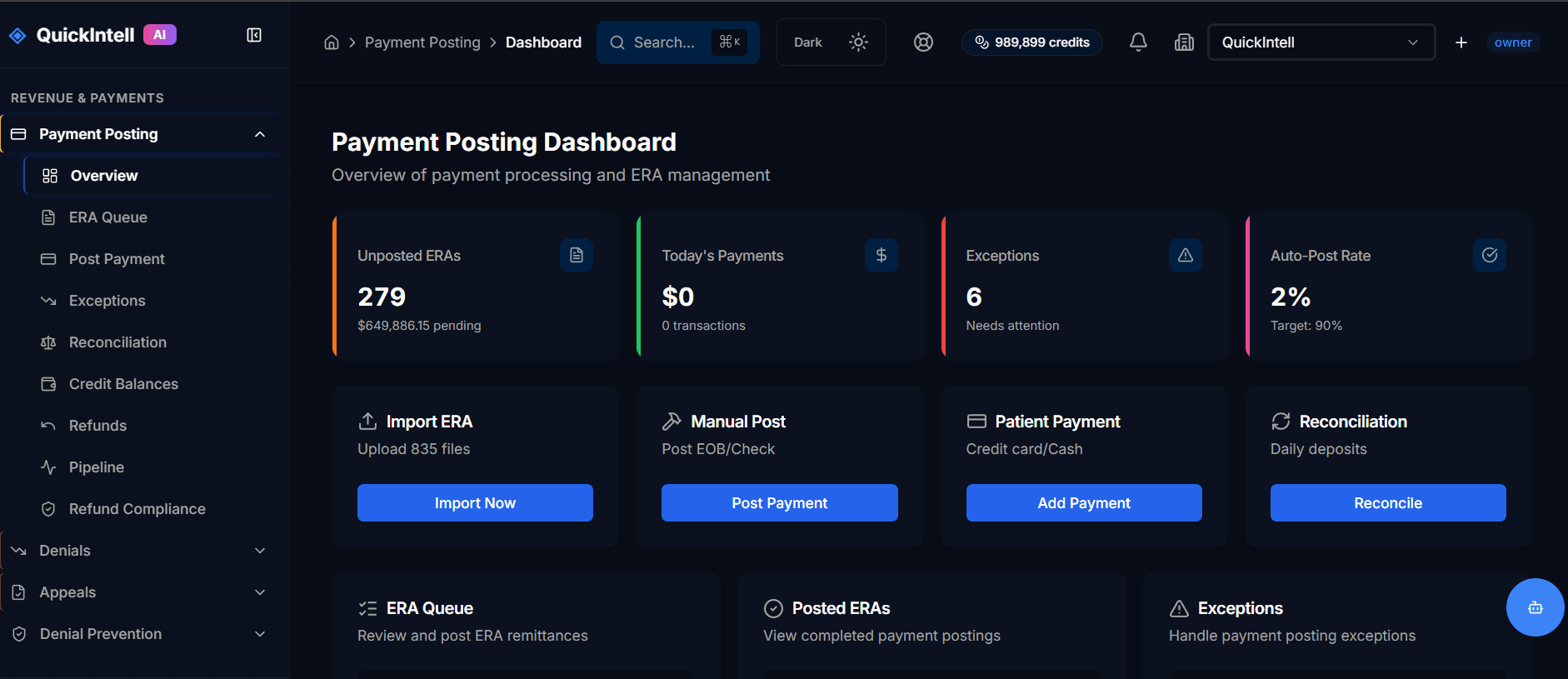
The Problem
You're stuck with hand-keying payments, slow reconciliation across EHR + lockbox + bank feeds, and missed adjustments/secondary balances.
It costs 3–5 AR days, $0.85–$1.40 per remit in labor, and avoidable rework and denials.
The Solution
Here's the simple way: Payment Posting ingests ERAs/EOBs, auto-matches to claims/patient ledgers, and applies adjustments/partials—so you hit >99% posting accuracy, same-day cash application, and zero blind spots in your remittance trail.
TL;DR — Payment Posting in 60 seconds
- >92% auto-post on top-5 payers in 90 days
- <1 day to post, down from 3–7
- 2.5–4% net-revenue recovery on silent underpayments
- 6–10 hours/week reclaimed per poster
- Triangle-of-Truth reconciliation closes batches in one click
"Posting accuracy went from 96.2% to 99.4%, and cash app time dropped to <24 hours across 18 practices."
— Maya Chen, VP Revenue Cycle, NorthBridge Multi-Specialty
Key Benefits
>99% posting accuracy
So you can cut rework by 60–75% and keep auditors happy.
2–3 days faster cash application
So you shrink DSO/AR days and forecast cash with confidence.
50–70% fewer manual touches
So you redeploy FTEs to high-value denials & patient AR follow-up.
How It Works
Connect
Securely connect payers/clearinghouse ERAs, bank/lockbox files, and your EHR/PMS/ERP via FHIR & SFTP/API in under a day.
Configure
Map CARC/RARC to house rules, set specialty-specific posting logic, and define exception queues & roles.
Run
Auto-ingest, normalize, and smart-match remits; apply allowed amounts, contract variances, write-offs, and COB / secondary balance creation.
Measure
Real-time dashboards for posting rate, exception rate, remittance variance, payer lag, with exportable audit trails.
Pipeline
Run the 10-step Post-Payment Pipeline with independent step retry, including the denial-routing handoff.
Feature Groups
Automate
- • ERA/EOB ingestion & normalization (835, CSV, PDF/OCR for paper EOBs)
- • Smart matching & auto-posting (partials, multi-line, bundled, interest, capitation)
Collaborate
- • Exception workqueues (payer variance, missing claim, contract mismatch) with SLA timers
- • Notes & assignments across billing/cash teams with role-based views
Control
- • Contract-aware adjustments (CARC/RARC mapping, allowed vs. paid variance limits)
- • Secondary/tertiary automation (balance transfer, statement holds, rebills)
Report
- • Cash & posting dashboards (by payer, facility, location, provider, CPT/DRG)
- • Full audit trail & export (posting logs, rule hits, user actions, evidence pack)
Reconcile
- • Triangle of Truth (bank = ERA = posted)
- • Variance drilldown by canonical bucket
- • Reverse Batch with manager approval
- • Duplicate trace number detection
Integrations
Works with: Epic, Cerner, Athenahealth, eClinicalWorks, NextGen, Allscripts/Altera, Greenway; Waystar, Availity, Change Healthcare, Experian; Netsuite, Sage Intacct, Microsoft Dynamics 365.
What it enables:
- • One-click mapping of payer codes to your GL & adjustment reason codes, with EHR write-back
- • Automated secondary creation and 837/276 triggers after primary post
- • Lockbox & bank feed reconciliation to eliminate orphan deposits
- • Contract variance alerts when paid ≠ allowed (by fee schedule)
Security & Compliance:
- • Encryption: Data encrypted in transit (TLS 1.2+) and at rest (AES-256)
- • Access: SSO/SAML/OIDC, MFA, RBAC with least-privilege policy
- • Audits: HIPAA, SOC 2 Type II controls; immutable posting logs & evidence exports
How QuickIntell compares
Built for mixed-EHR revenue cycle teams that need automation, reconciliation, and audit evidence beyond simple remit delivery.
| Capability | QuickIntell | In-house Epic Resolute | Legacy clearinghouse posting | Manual posters |
|---|---|---|---|---|
| million-line ERA handling | Async large-file path with chunked processing and progress visibility. | Strong inside Epic; mixed-EHR books still need extra coordination. | Usually delivers the remit, then leaves large-file operations to your team. | Splits, spreadsheets, and overtime for high-volume payer files. |
| legacy-EHR support without FHIR | Supports FHIR, API, SFTP, and browser-assisted workflows for older systems. | Best when the whole workflow stays in one Epic environment. | Limited write-back after the remittance reaches the clearinghouse. | Depends on re-keying and local knowledge of each EHR screen. |
| 10-step pipeline with independent retry | Each post-payment step can retry without blocking completed downstream work. | Configurable workflows, but exceptions often need Epic-specific ownership. | Posting stops at matching; follow-on tasks are often separate queues. | Hand-offs depend on checklists, inboxes, and supervisor follow-up. |
| underpayment recovery surfaced (not buried) | Contract variance is promoted into recovery workflows instead of buried in remits. | Can work well with mature contract-build teams and clean configuration. | Variance may be visible, but recovery often becomes a separate analyst project. | Silent underpayments are easy to miss unless a poster spots the pattern. |
| audit-grade evidence pack | Posting logs, rule hits, user actions, and source evidence export together. | Auditable inside Epic; cross-system evidence can require stitching exports. | Remittance evidence exists, but operational decisions live elsewhere. | Audit trail depends on notes, screenshots, and manager review discipline. |
Pricing
Starter
For clinics & small groups (up to 25k remits/month)
- • Auto-posting ERAs, paper EOB OCR (up to 5k pages), exception queues
- • Standard dashboards & exports, email support
Growth
For multi-site groups/MSOs (up to 150k remits/month)
- • Everything in Starter + contract variance engine, secondary automation, SSO/MFA
- • Advanced dashboards (payer lag, variance drilldowns), priority support
Scale
For health systems & RCM BPOs (150k+ remits/month)
- • Everything in Growth + dedicated VPC, HA/DR, custom rules, sandbox, premium SLA
- • Enterprise integrations (ERP/GL), audit evidence pack & quarterly ops reviews
(Volume-based pricing; enterprise discounts and BPO pricing available.)
Frequently Asked Questions
Field results show >99% on digital ERAs and 98–99% on OCR'd paper EOBs after initial tuning.
We use OCR + ML normalization with human-in-the-loop exceptions and learn from corrections to improve.
Yes—configurable rules will generate secondary, transfer balances, and queue any exceptions.
Via contract-aware rules mapped to your CARC/RARC + internal reason codes, with variance limits.
We route to an exception queue with smart suggestions (payer ID, DOS, amount, NPI); every action is logged.
Yes—bank/lockbox import reconciles deposit amounts to posted remits to eliminate orphan cash.
Typical go-live in 2–3 weeks (faster for standard EHRs/clearinghouses). Data mapping is templatized.
Dashboards track posting rate, exception rate, AR days, cash-to-post time, variance by payer—exportable.
Large Medicare and commercial ERA files route to an async worker with chunked processing and progress visibility, so posters can track completion without UI lag or memory failures.
Yes. QuickIntell compares payments against contract terms and allowed amounts, then promotes underpayment variances into recovery workflows instead of leaving them buried in remits.
QuickIntell falls back to Stagehand browser automation for legacy EHRs and portals, using governed, auditable workflows when a direct FHIR or API connection is not available.
Reversals are gated by role-based permissions and separation-of-duties controls. A supervisor can reverse on a poster's behalf with an override reason, and every action is logged.
Configurable retention windows; self-serve exports (CSV/JSON) and scheduled SFTP drops.
Yes—no-code rule builder plus advanced custom logic for fee schedules and specialty nuances.
Related QuickIntell Products
QuickERA — EOB to ERA Conversion
Convert paper EOBs into clean 835 ERAs automatically across 3,500+ payors.
QuickRCM — End-to-End AI RCM
Automate the full revenue cycle from eligibility through payment posting.
Denial Management
AI-powered denial prevention and automated appeals to recover more revenue.
Claims Processing
AI claims filing and scrubbing for greater than 95% first-pass acceptance.