QuickVoice AI Voice Agents for Providers
Inbound and outbound calls for scheduling, reminders, balances, and eligibility
QuickVoice places outbound reminders, balance reminders, recall, and eligibility re-verification calls, then answers inbound scheduling and billing calls with live transcripts, human escalation, and structured EHR/RCM write-back.
For provider teams
- Reduce no-shows with reminder, cancellation, reschedule, and recall campaigns.
- Answer inbound scheduling and billing calls before the front-desk queue backs up.
- Write structured outcomes back to EHR, scheduling, eligibility, and Patient AR systems.
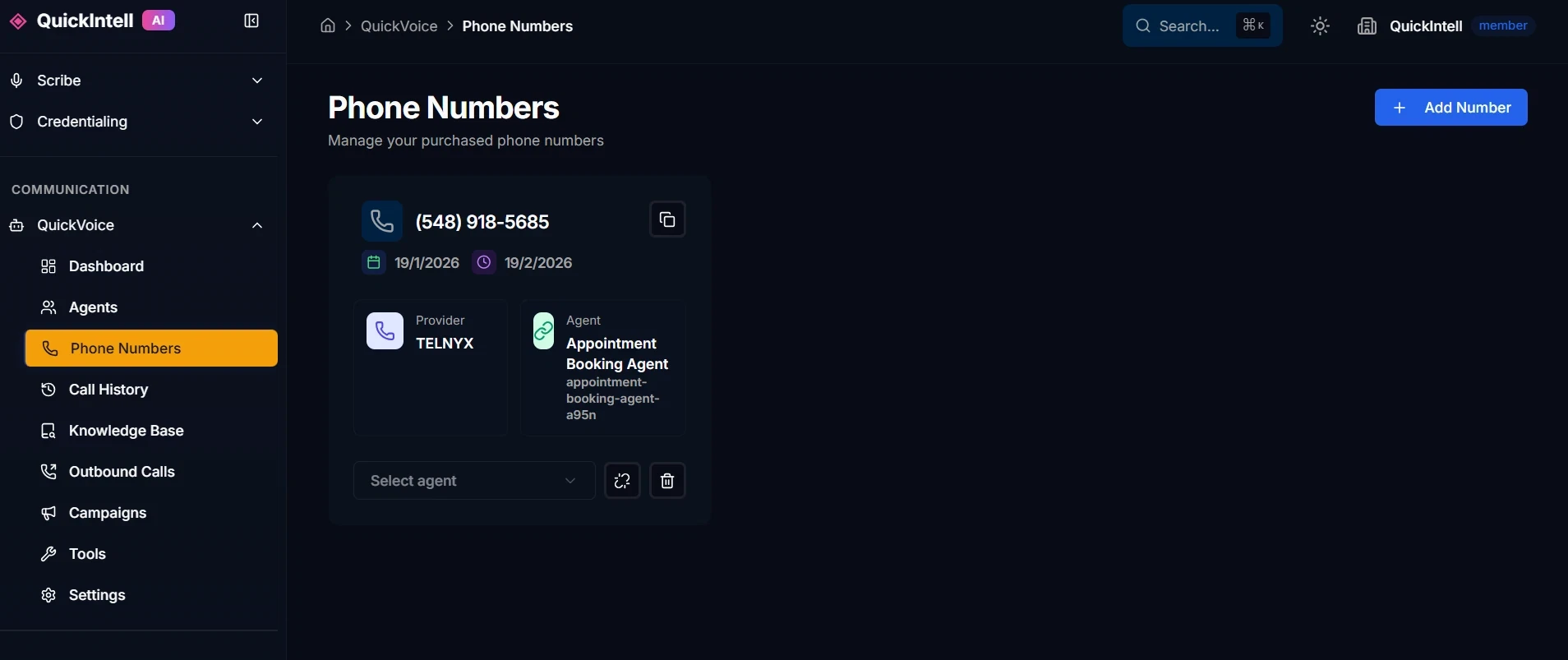

What QuickVoice handles
The QuickVoice telephony layer works from your scheduling, eligibility, EHR, and Patient AR context so routine calls finish with a recorded outcome instead of a sticky note.
Reminder Campaigns
Confirm tomorrow's appointments, capture cancellations, leave voicemail outcomes, and flag callbacks.
Inbound Scheduling
Answer published scheduling lines, verify identity, confirm appointments, and route complex requests.
Balance and Payment Plan Calls
Discuss balances, capture promise-to-pay or payment-plan acceptance, and update Patient AR.
Eligibility Re-verification
Call patients with stale or partial coverage, collect updated insurance details, and re-trigger eligibility.
Recall Campaigns
Reach cohorts due for follow-up, log connect rates, and send structured outcomes back to scheduling.
Referral Callbacks
Return referral-related calls, capture patient intent, and route follow-up to the right human queue.
Controls Provider Teams Expect
Always-on Coverage
QuickVoice answers routine inbound calls and runs approved outbound campaigns without adding front-desk workload.
Structured Call Outcomes
Calls are classified into outcomes such as confirmed, cancelled, payment promised, opt-out, or needs review.
HIPAA-aware Controls
Identity checks, minimum-necessary scripts, RBAC, transcript permissions, and encrypted recordings protect patient data.
Operational Reporting
Dashboards track connect rate, outcome rate, cost per outcome, opt-outs, and calls requiring human review.
Provider Call Workflows

Outbound Appointment Reminders
QuickVoice confirms, cancels, reschedules, or leaves voicemail for upcoming appointments.
Inbound Patient Triage
Routine inbound scheduling and billing calls are answered first, with clinical questions escalated.
Balance Reminders
Patient balance outreach captures payment promises and payment-plan interest for Patient AR.
Eligibility Re-verification
Stale or partial coverage triggers patient calls that collect updated insurance information.
Recall Campaigns
Campaigns reach overdue cohorts and write call outcomes back to scheduling and reporting.
Referral Callbacks
Referral-related callbacks are routed to the right team when the agent cannot resolve them.
Human Escalation
Low-confidence, out-of-scope, or requested human conversations transfer or create callback tasks.
Transcripts and Write-back
Every call is transcribed, classified, and written back to EHR, scheduling, eligibility, or AR systems.
Frequently Asked Questions
What calls does QuickVoice handle for providers?
QuickVoice handles outbound appointment reminders, recall campaigns, balance reminders, eligibility re-verification, referral callbacks, and routine inbound scheduling or billing calls.
Does QuickVoice integrate with my EHR or PMS?
QuickVoice reads from Scheduling, Patient AR, Eligibility, and EHR/PMS connectors, then writes structured outcomes back through configured integrations such as FHIR, REST, or supported automation.
How does QuickVoice handle HIPAA and TCPA safeguards?
QuickVoice uses identity checks, minimum-necessary scripts, RBAC, encrypted recordings, transcript permissions, patient-local quiet hours, DNC handling, and compliance checks before calls are placed.
Can patients reach a human?
Yes. Patients can ask for a person, and QuickVoice can transfer the call or create a callback task. Low-confidence and out-of-scope conversations are also escalated.
How is QuickVoice priced?
Pricing is scoped around implementation, call volume, telephony usage, AI usage, and the workflows you enable. QuickIntell reviews the operating model during a demo before quoting.
What are QuickVoice's limitations?
QuickVoice does not replace licensed clinical judgment, does not improvise clinical answers outside the approved knowledge base, and still depends on accurate source data such as phone numbers, time zones, and EHR mappings.
Compliance and control
QuickVoice keeps call automation inside healthcare operating rules, and the Trust Center is where provider teams can review QuickIntell security and compliance documentation.
HIPAA and BAA Coverage
QuickVoice is designed for HIPAA workflows, with BAA support and minimum-necessary patient scripts.
Recording and Transcript Access
Recordings are encrypted at rest, call access is RBAC-gated, and transcript export uses separate permissions.
Dialing Rules
TCPA quiet hours, patient-local time, DNC opt-outs, and FDCPA Reg-F collection limits are enforced before dialing.
Human Escalation
Clinical, low-confidence, out-of-scope, or requested human conversations transfer or create callback tasks.
Connected QuickIntell workflows
QuickVoice
Voice agent setup, campaign management, transcripts, and call history.
Eligibility
Coverage checks that feed re-verification calls and receive updated insurance details.
QuickAuth
Prior authorization workflows for requests that move beyond a patient callback.
Accounts Receivable
Patient balances, payment promises, payment plans, and collection follow-up.
Integrations
EHR and PMS connectors that support patient data and write-back.
Trust Center
HIPAA, BAA, security controls, and compliance documentation.