Centralize Revenue Operations for Multi-Practice MSOs
AI-powered workflows for management services organizations coordinating billing, documentation, and collections across affiliated practices.
QuickIntell helps MSO teams standardize centralized revenue cycle operations, surface multi-practice performance trends, and automate complex administrative work so every location has cleaner claims, faster follow-up, and clearer operational oversight.
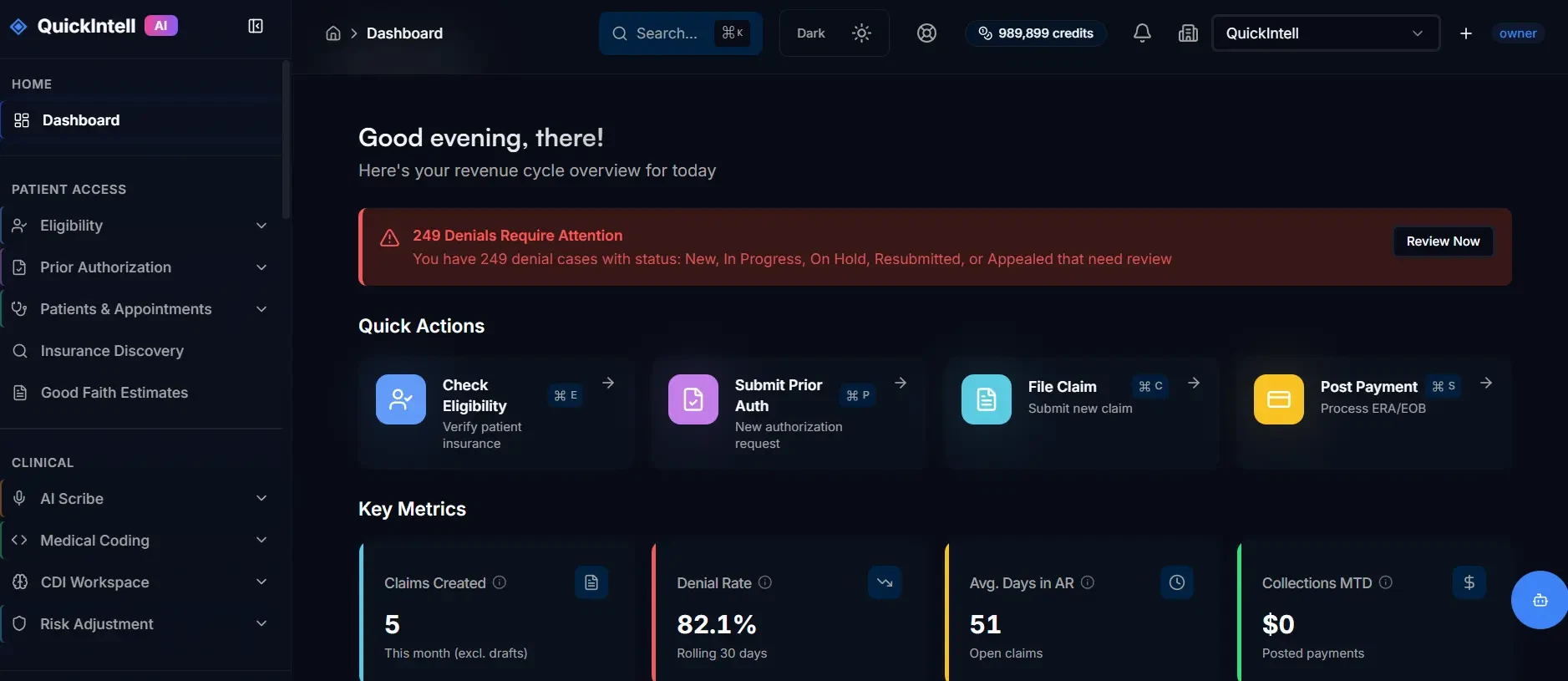

Executive TLDR
What MSO leaders get from QuickIntell
Fewer avoidable denials from eligibility, documentation, and claim-readiness checks
Faster payment posting with cleaner ERA matching, exceptions, and reconciliation workflows
Payer enrollment visibility across provider readiness, status, gaps, and follow-up
AR work queues that prioritize payer follow-up, underpayments, appeals, and aging risk
Governed automation with scoped access, audit trails, and human review where needed
Our Core Offerings: AI-Powered Solutions
Comprehensive AI solutions designed to revolutionize healthcare operations and improve patient outcomes

AI RCM
Automated revenue cycle management with intelligent claims processing, eligibility verification, and denial management.
AI Classification
Intelligent document classification and data extraction from clinical documents for improved workflow efficiency.
AI Eligibility Verification
Automate insurance eligibility checks in real-time to reduce claim denials and accelerate patient intake workflows.
AI Scribe
Automated clinical documentation that captures patient encounters in real-time, freeing physicians to focus on patient care.
AI Voice Agents
Intelligent voice agents that handle patient interactions, appointment scheduling, and administrative tasks 24/7.
Healthcare Analytics
Advanced analytics and reporting tools that provide insights into operational performance and patient outcomes.
Ready to Transform Your Healthcare Operations?
Discover how QuickIntell's AI solutions can revolutionize your healthcare organization and improve patient care.
MSO Operating Model
Run every client tenant with the right boundaries
QuickRCM organization controls support MSO and RCM service-company operations where each practice needs isolated data, configurable access, branded workflows, and evidence-ready oversight.

Multi-tenant org switching
Operators move between client tenants from the org switcher while queries, records, modules, and users remain scoped to the active organization.
RBAC and least privilege
Owners and admins assign job-based roles, stack permissions by function, expire contractor access, and run least-privilege reviews.
Per-client reporting
Client-specific dashboards, facility filters, exports, and QBR-ready reports keep performance, access, and module use separated by tenant.
White-labeling
Each tenant can carry its own logo, brand colors, custom domain, enabled modules, and client-facing communication experience.
Append-only audit logs
Member changes, feature toggles, patient access events, approvals, exports, and denied actions remain traceable by user, time, target, and reason.
Scoped operating teams
Department leads can manage focused teams across coding, AR, front desk, reports, and compliance without opening unrelated resources.
Every record carries organization scope, and every sensitive action writes to an audit trail for compliance review.
Back-End RCM
Coordinate the back office from posted cash to recovered revenue
The MSO page now reflects the back-end revenue-cycle modules that operations leaders actually manage across client books of business.
Payment posting
ERA inboxes, 835 parsing, auto-match summaries, exception queues, manual EOB posting, deposit reconciliation, and EHR ledger write-back keep cash moving.
Patient AR
Statements, Stripe-hosted portal payments, auto-charge payment plans, disputes, aging buckets, and collection tasks manage patient responsibility.
AR management
Priority queues surface payer follow-up, timely filing risk, missing information, underpayments, SLA breaches, and manager escalations.
Appeals
Denied and underpaid claims become appeal work with templates, required document checks, peer-to-peer support, deadline tracking, and outcome posting.
Insurance discovery
Self-pay balances can be scanned for hidden active coverage, verified through eligibility, written back to the EHR, and rebucketed to insurance AR.
Contract management
Loaded fee schedules, underpayment sweeps, prompt-pay dispute letters, rate simulations, and recovered-payment reconciliation help protect contracted revenue.
Payment outcomes, patient balances, underpayment variances, appeals, and discovery results all feed downstream work queues and analytics.
Track provider readiness before it becomes claim leakage
Credentialing and payer enrollment controls help MSOs understand which providers can bill which payers, where rosters are stale, and which gaps are blocking revenue.
CAQH readiness
CAQH IDs, attestation dates, credentials, document completeness, work history, licenses, and OIG checks stay visible before enrollment starts.
Provider matrix
Rows of providers and columns of payers reveal not enrolled, pending, restricted, active, suspended, terminated, and recredentialing-due states.
Roster submissions
Delegated and group updates can generate CAQH-standard, EDI 274, CSV, or spreadsheet rosters with add, remove, and update diffs.
Enrollment-gap analysis
Revenue-at-risk views prioritize missing provider-payer combinations by estimated daily loss and open a pre-filled application workflow.
Application follow-up
Deficiencies, payer follow-up notes, submission aging, effective dates, and escalation history stay in one audit-ready enrollment record.
Claims gating
Active payer status flows to Claims and the EHR so submissions can be blocked when a provider is not enrolled, suspended, or terminated.
Credentialing produces the verified profile, and Payer Enrollment turns it into payer applications, roster updates, and active billing status.
Automation Governance
Scale AI agents through controlled operating modes
MSO automation is governed through Agent Builder, Pipeline Orchestration, approval queues, credit limits, circuit breakers, and the organization kill switch.
Agent Builder
Teams clone healthcare templates, attach vaulted credentials, map extracted fields, test against known-good inputs, and schedule agents by CRON, event, or manual run.
Approval gates
Write actions can pause with action plans, source data, screenshots, extracted JSON, reviewer notes, approver IDs, and approve or reject outcomes.
Notify Only to Automatic
Automation Points can run Off, Notify Only, Semi-Automatic, or Automatic, with payer, specialty, facility, and tenant overrides.
Circuit breakers
Failed-run thresholds, breaker states, root-cause review, half-open probes, and reset controls keep unhealthy automation from repeating bad work.
Credit caps
Per-agent daily run limits, daily credit caps, organization credit checks, and monthly spend reconciliation prevent runaway automation cost.
Kill switch
An organization-level kill switch blocks new tasks and stops active sessions when a portal change, bad source record, or security incident needs immediate containment.
New workflows can observe first, route to human review, and only graduate to automatic execution once quality and exception metrics are stable.
Revolutionizing Revenue Cycle Management
Our AI-powered Revenue Cycle Management (RCM) solution automates critical functions, including eligibility verification, prior authorizations, medical coding, claims processing, and denial management. By minimizing manual efforts and maximizing accuracy, we help healthcare organizations achieve significant cost savings, reduce denials, and improve revenue recovery.
Key Benefits:
- Substantial cost savings through automation
- Improved revenue capture through accurate billing and coding
- Enhanced compliance with regulatory requirements


Intelligent Document Classification and Data Extraction
Our AI Classification solution accurately identifies, categorizes, and extracts critical information from various clinical documents, improving data accuracy and streamlining administrative workflows.
Document Types:
Streamlining Clinical Documentation with AI Scribe
Our AI Scribe solution transforms natural patient-clinician conversations into structured, high-quality clinical notes in the EHR, saving time and improving documentation quality.
Supported Formats:
Key Features:
- Real-time speech-to-text conversion
- Automatic medical terminology recognition
- Seamless EHR integration


AI Voice Agents: Enhancing Patient Experience and Operational Efficiency
Our AI Voice Agents automate administrative tasks, such as pre-authorization, appointment management, and feedback capture, enhancing patient satisfaction and operational efficiency.
Pre-Authorization Features:
- Seamless voice interactions
- Real-time status tracking
- Efficient insurance verification
- Multi-channel submission
- Seamless EHR integration
Additional Capabilities:
Why Choose QuickIntell?
Discover what makes our AI solutions the preferred choice for healthcare organizations worldwide
Human-like Agents
Our AI agents emulate human cognitive functions, integrating into existing workflows to automate routine tasks with natural interaction patterns and contextual understanding.
Workflow-Specific Review
Leveraging advanced NLP and Computer Vision, our workflows help extract and interpret complex healthcare data, routing exceptions for human validation before downstream action.
Scalable Intelligence
Our AI platform is designed for rapid deployment and is highly configurable, scaling effortlessly to meet evolving healthcare needs and growing organizational demands.
Compliance & Security
We are built with robust security protocols and HIPAA-aligned safeguards, helping protect patient health information and support regulated healthcare operations.
Empowering Healthcare Providers for Quality Care
By automating routine tasks and minimizing administrative burdens, QuickIntell's AI solutions enable healthcare providers to focus on delivering exceptional patient care. Our solutions have achieved remarkable results across various healthcare organizations.
Measurable Impact:
Reduction in Administrative Costs
Significant cost savings through AI automation
Decrease in Processing Time
Faster turnaround for critical healthcare processes
Increase in Revenue Capture
Improved billing accuracy and claim processing
Additional Benefits:
- Reduced physician burnout through automation
- Improved patient satisfaction scores
- Enhanced compliance and audit readiness

Frequently Asked Questions
Get answers to common questions about QuickIntell for MSO operations, tenant controls, revenue-cycle workflows, reporting, and governed automation.
Still have questions? Our experts are here to help!
Join the Healthcare AI Revolution
Ready to transform your healthcare operations? Contact us today to schedule a personalized consultation and discover how QuickIntell's AI solutions can drive measurable impact for your organization.
