AI RCM and Patient Access Automation for Pharma & Life Sciences
Coordinate eligibility, prior authorization, patient responsibility estimates, claims handoffs, and AR follow-up in one QuickRCM workflow.
QuickIntell helps pharma and life sciences teams keep coverage, authorization, claims, payment posting, and Patient AR data moving between access, operations, and analytics teams.
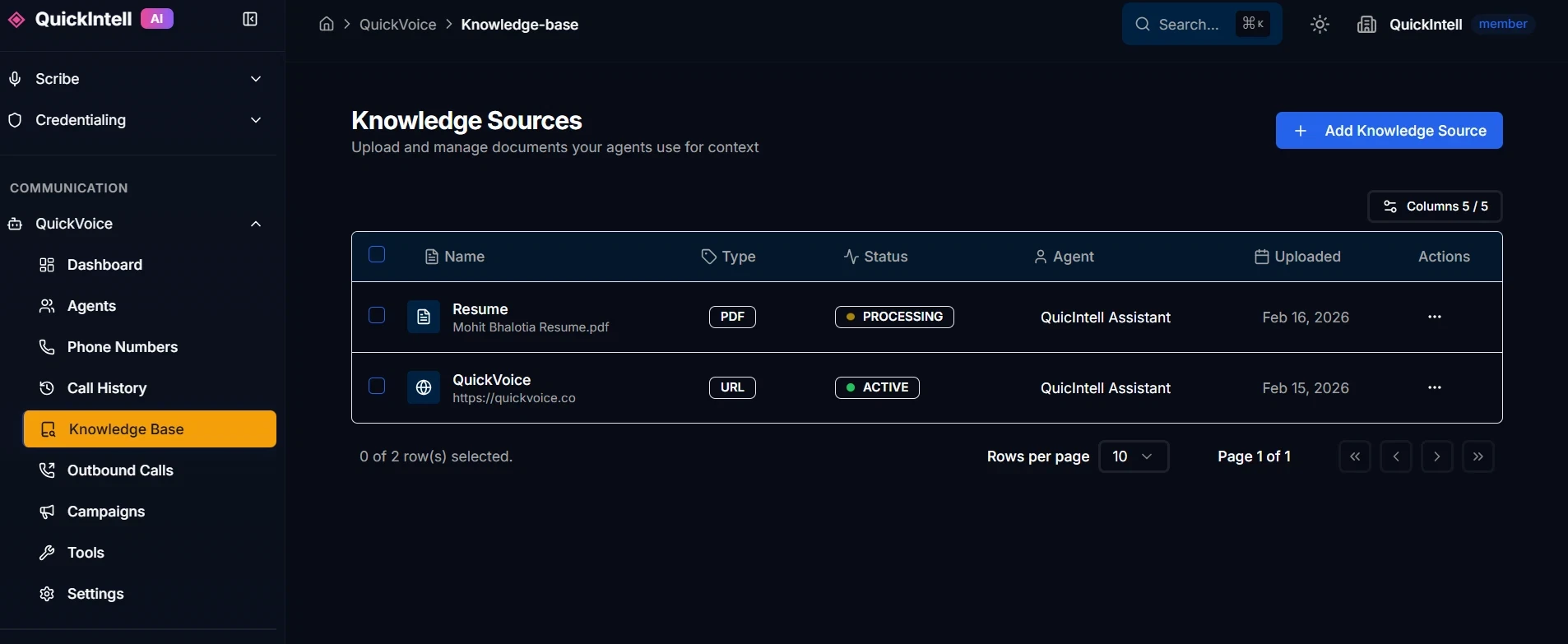

Patient access and RCM automation for pharma operating teams
QuickIntell gives pharma and life sciences teams one governed workflow for coverage verification, authorization, documentation, revenue-cycle handoffs, outreach, and reporting.
- Built for
- Access, reimbursement, hub operations, specialty-services, and life sciences teams that need governed patient access and RCM handoffs.
- Automates
- Eligibility, prior auth, documentation, coding, claims, denial prevention, QuickVoice outreach, AR follow-up, and analytics workflows.
- Connects
- EHR and practice-management data, clearinghouse routing, payer portals, fax paths, APIs, and file-based operating workflows.
- Outcomes
- Faster coverage checks, cleaner submissions, fewer avoidable denials, shorter AR cycles, and clearer operating dashboards.
- Compliance posture
- HIPAA-aware workflows, BAAs, SOC 2 evidence, RBAC, audit logs, PHI controls, and customer-controlled automation modes.
One operating workflow from access to analytics
QuickIntell connects the core operating steps documented across Eligibility, Prior Auth, AI Scribe, Coding, Denials, Claims, Payment Posting, AR, and Analytics workflows.
Runs 270/271 checks from schedules, walk-ins, or stale coverage queues, then returns active coverage, copay, deductible, and out-of-pocket status.
Handoff: Writes verified coverage to the EHR and feeds Prior Auth, Patient AR, Claims, and Analytics.
Detects whether a service needs authorization, drafts the request, validates fields and clinical documents, submits through EDI, portal automation, or fax, and polls status.
Handoff: Approved authorization numbers move downstream to Claims and renewal tracking.
Turns patient-clinician conversations into structured SOAP notes, keeps providers in attestation control, and writes finished documentation back to the chart.
Handoff: Signed notes automatically queue Medical Coding with codable context.
- 04
Coding
Suggests ICD-10, CPT, HCPCS, modifiers, HCCs, and E/M levels, then runs scrub logic and structured clarification workflows before claims are built.
Handoff: Accepted codes flow to Claims with audit context and EHR write-back.
- 05
Denials
Scores draft claims against payer patterns, denial history, eligibility context, and authorization status so fixable risks are resolved before submission.
Handoff: Low-risk claims clear forward; high-risk findings return to coding or billing work queues.
- 06
Claims
Builds payer-ready 837P, 837I, or 837D files, checks scrub results, routes through Availity or Stedi, and tracks payer responses.
Handoff: Accepted claims move to adjudication and Payment Posting; rejected claims enter correction loops.
Reads 835s and EOBs, matches payments to claims, auto-posts clean remittance lines, and routes exceptions, denials, patient balances, and underpayments.
Handoff: Posted outcomes update Patient AR, Denials, AR Management, and reconciliation dashboards.
- 08
AR
Prioritizes unpaid work by aging, payer status, timely-filing risk, underpayment variance, and SLA breach so specialists work the right claims first.
Handoff: Follow-up actions, letters, escalations, and outcomes are logged and visible to Analytics.
Combines eligibility, PA, scribe, coding, claims, denials, payments, AR, and voice outcomes into dashboards with drill-downs to source records.
Handoff: Leaders see clean-claim rate, denial rate, days in AR, underpayments, and workflow health in one view.
Approved operating targets across the revenue loop
These manual-backed benchmarks connect access, authorization, documentation, claims, payment, AR, analytics, and voice automation outcomes.

- Eligibility hours saved
- 20-35 to 3-5 hrs/wk
- Manual phone calls and payer portal checks shrink after automated eligibility sweeps.
- Denial reduction
- 40-55%
- Claims Management targets a 90-day denial drop, with Denial Prevention reducing avoidable issues before submission.
- Clean-claim rate
- 95-97%
- Clean-claim targets rise from an 82-86% baseline when scrub and correction loops are live.
- PA turnaround
- <1 business day
- Median prior authorization turnaround for clean submissions moves down from 3-5 business days.
- Days-in-AR improvement
- 8-12 days faster
- Payment posting and AR workflows shorten cash timing in the first quarter.
- Call completion
- ~98%
- Reminder-call completion improves from roughly 55% when QuickVoice handles outreach capacity.
Controls for PHI, voice, and automation
Pharma and life sciences workflows often touch coverage, authorization, payment, patient outreach, and clinical documentation. QuickIntell keeps those workflows governed through contractual, technical, and operational controls.
HIPAA, BAA, and PHI controls
PHI is handled with encryption in transit and at rest, minimum-necessary workflows, BAA-backed handling, and no customer PHI used to train third-party models.
SOC 2 Type II evidence
Security, availability, confidentiality, processing integrity, and privacy controls can be reviewed through the enterprise security process.
RBAC and audit logs
Role-based permissions scope read, write, approve, and export actions while sensitive workflow actions are captured in audit logs.
Voice identity checks
Strict HIPAA Mode can require caller name and date of birth verification before balances, appointments, or account-specific details are discussed.
Governed automation note
Automation modes such as NOTIFY_ONLY, SEMI_AUTOMATIC, AUTOMATIC, and DISABLED keep high-impact work under customer control. Externally facing compliance claims, scripts, and governed automation defaults remain subject to legal approval.
Transforming Healthcare Administration
At QuickIntell, we're harnessing the power of cutting-edge AI technologies to revolutionize healthcare operations. Our AI-driven solutions are designed to streamline administrative tasks, enhance clinical workflows, and improve patient outcomes.
Our comprehensive suite of AI-powered tools addresses the most critical challenges facing healthcare organizations today, from revenue cycle management to clinical documentation and patient engagement.
Intelligent Automation
Reduce manual tasks by up to 95% through AI-powered process automation.
Data-Driven Insights
Leverage advanced analytics to optimize operations and improve decision-making.
Seamless Integration
Connect with existing systems through open APIs and standard protocols.

AI-Powered Revenue Cycle Management (RCM)
Our AI RCM solution is transforming the way healthcare organizations manage their revenue cycles. By automating eligibility verification, prior authorizations, medical coding, claims processing, and denial management, we're helping providers maximize revenue and reduce manual effort.
Substantial Cost Savings
Reduce administrative costs by up to 95% through automation of manual tasks and intelligent process optimization.
Reduced Denials
Improve first-pass claim acceptance rates with AI-powered accuracy and predictive analytics.
Improved Revenue Recovery
Capture more billable services and optimize reimbursement through intelligent claim processing.
Real-Time Analytics
Monitor revenue performance with live dashboards and actionable insights for continuous improvement.
Intelligent Document Classification
Our AI-powered document classifier accurately identifies, categorizes, and extracts critical information from various clinical documents. This capability improves data accuracy, accelerates information retrieval, and streamlines healthcare administrative workflows.
Emergency Room (ER) Notes
Capture initial assessments and treatment plans with intelligent data extraction and classification.
Discharge Summaries
Process comprehensive patient outcomes and follow-up care instructions automatically.
Operative Reports
Extract detailed surgical procedures and post-operative care instructions with precision.
Medical Records
Automatically classify and organize patient medical records for efficient retrieval and analysis.


AI Scribe: Real-Time Clinical Documentation
Our AI Scribe transforms natural patient-clinician conversations into structured, high-quality clinical notes in real-time. This reduces documentation burden for providers and enhances overall data quality.
Supported Documentation Formats
SOAP notes, H&P templates, APIR, PIE, and custom templates with intelligent formatting.
Exceptional Accuracy
Less than 1% Word Error Rate (WER) and 99% average completeness score for reliable documentation.
Real-Time Processing
Generate clinical notes instantly during patient encounters for improved workflow efficiency.
Customizable Templates
Adapt to your practice's specific documentation requirements and clinical workflows.
QuickVoice AI Voice Agents: Streamlining Administrative Tasks
Our AI Voice Agents automate and streamline administrative tasks, including appointment scheduling, pre-authorizations, and patient interactions through natural language processing.
Pre-Authorization
Automate submission, tracking, and follow-up with payers for faster approval processes.
Appointment Management
Handle scheduling, rescheduling, and cancellations via natural voice conversations with patients.
Feedback Capture
Engage patients post-visit to gather comprehensive feedback and improve service quality.
24/7 Availability
Provide round-the-clock support for patient inquiries and administrative tasks without human intervention.


Why QuickIntell?
Human-like Agents
Emulate human cognitive functions to automate routine tasks with natural language understanding and contextual awareness.
Unmatched Precision
Achieve superior accuracy in extracting and interpreting complex healthcare data through advanced machine learning algorithms.
Scalable Intelligence
Designed for rapid deployment and highly configurable to meet evolving healthcare needs and organizational growth.
Compliance & Security
Built with robust security protocols and fully HIPAA compliant to protect sensitive patient information and ensure regulatory adherence.
Proven ROI
Demonstrated cost savings and efficiency improvements across multiple healthcare organizations with measurable results.
Frequently Asked Questions
Get answers to common questions about AI eligibility verification agents and how they can transform your healthcare operations.
An AI eligibility verification agent is an intelligent software system that automatically checks patient insurance coverage, benefits, and eligibility status using artificial intelligence and machine learning algorithms to streamline the verification process.
AI improves accuracy by learning from historical data, recognizing patterns in insurance responses, and continuously improving its verification logic to reduce errors and increase first-pass acceptance rates.
AI agents can verify coverage details, deductibles, copays, coinsurance, benefit maximums, pre-authorization requirements, network status, and claim submission guidelines across multiple insurance carriers.
AI agents can process eligibility verifications in seconds, compared to traditional manual processes that typically take 15-30 minutes per patient, resulting in significant time savings.
Yes, AI agents can simultaneously verify eligibility across multiple insurance carriers, secondary insurance, and supplemental plans, providing comprehensive coverage information in a single verification process.
When responses are unclear, AI agents flag the verification for human review, provide confidence scores, and suggest alternative verification methods to ensure accuracy and compliance.
AI agents maintain HIPAA compliance through encrypted data transmission, secure authentication protocols, audit trails, and role-based access controls that protect patient information throughout the verification process.
Yes, AI agents are designed with open APIs and standard integration protocols to seamlessly connect with existing practice management systems, EHRs, and billing software.
AI eligibility agents use guided workflows and intuitive interfaces to reduce training overhead, with implementation support tailored to each team's roles, systems, and verification process.
AI agents continuously monitor insurance policy changes, automatically update verification protocols, and adapt to new requirements to ensure current and accurate eligibility information.
AI agents provide comprehensive reports on verification success rates, processing times, error patterns, cost savings, and ROI metrics to help optimize operations and demonstrate value.
Yes, AI agents can verify eligibility for specialized procedures by accessing procedure-specific coverage requirements, pre-authorization needs, and benefit limitations across different insurance plans.
AI agents automatically distinguish between network and out-of-network providers, verify coverage levels for each scenario, and provide clear guidance on patient financial responsibility.
AI systems include redundant verification methods, manual override capabilities, and fallback procedures to ensure continuous eligibility verification even during system maintenance or technical issues.
AI agents improve patient satisfaction by providing faster, more accurate cost estimates, reducing billing surprises, and streamlining the check-in process with pre-verified coverage information.
AI agents can help capture international coverage details, organize supporting documentation, and route unclear coverage scenarios for staff review. Verification depends on the payer, plan, and available integration path.
AI agents use anonymized historical verification data, insurance response patterns, and outcome analytics to continuously improve accuracy, reduce errors, and optimize verification workflows.
AI agents monitor for seasonal changes, temporary coverage modifications, and special enrollment periods, automatically adjusting verification protocols to reflect current insurance status.
Practices typically see 60-80% reduction in manual verification time, 40-60% decrease in claim denials, and 25-40% improvement in revenue cycle efficiency, resulting in significant cost savings.
AI agents support configurable rules, role-based access, audit trails, and exception routing. Jurisdiction- or payer-specific requirements should be configured and reviewed with the organization's compliance and legal teams.
Market Opportunity
The global healthcare AI market is projected to reach $194 billion by 2030. QuickIntell is poised to capitalize on this growth by providing AI-driven solutions that reduce administrative burdens, combat inefficiencies, and empower providers for quality care.
Our innovative approach to healthcare automation positions us at the forefront of this rapidly expanding market, offering solutions that address the most pressing challenges facing healthcare organizations today.

Ready to Revolutionize Your Healthcare Operations?
Ready to streamline your revenue cycle management, intelligently classify documents, automate eligibility verification, empower clinicians with AI Scribe, and coordinate outreach with QuickVoice?