Hospital EOB-to-ERA Workflow Planning
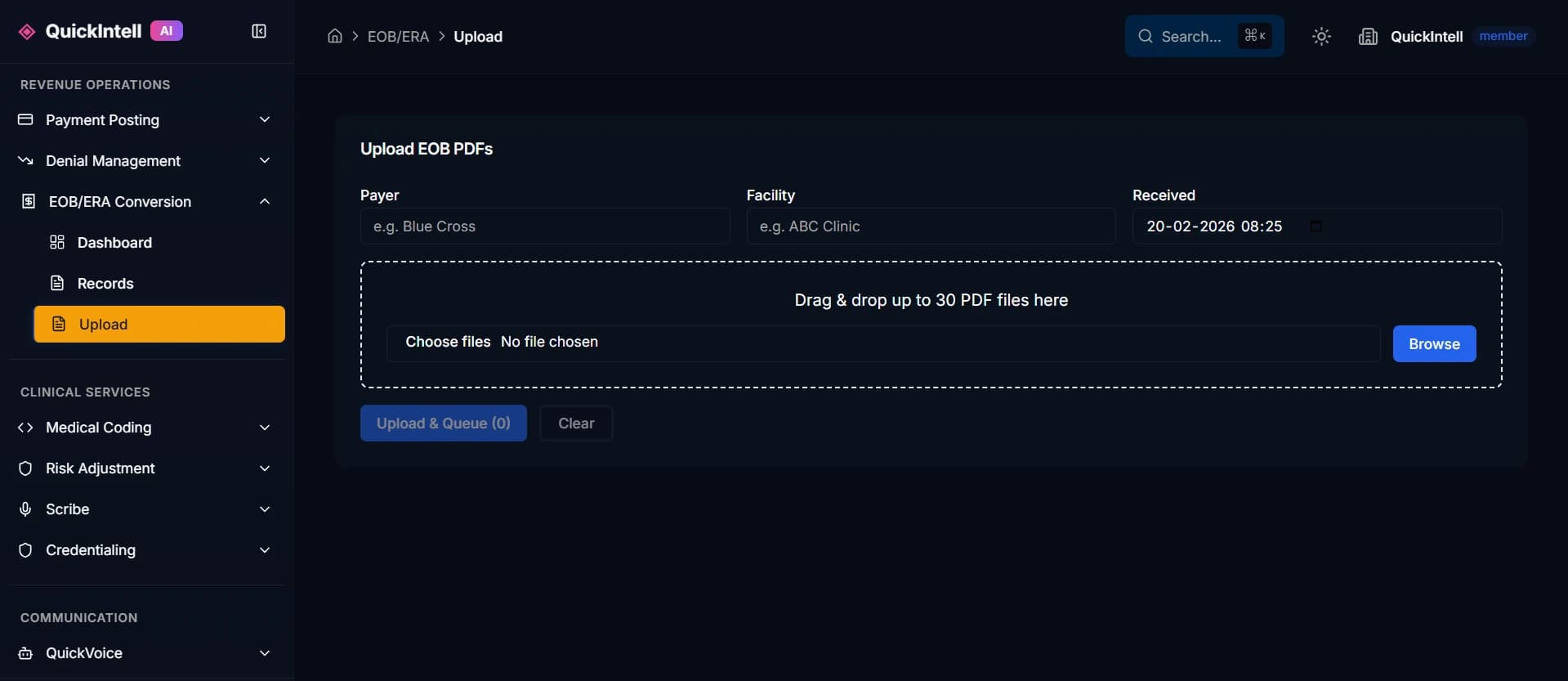
A hospital EOB-to-ERA workflow needs an accountable handoff from document intake to the correct billing operation and treasury reconciliation. Conversion a...
A hospital EOB-to-ERA workflow needs an accountable handoff from document intake to the correct billing operation and treasury reconciliation. Conversion alone does not decide which facility owns a payment, which account should receive it, or who resolves an exception. Define those decisions before moving a paper backlog into automated processing.
This guide provides a planning model for hospital revenue-cycle, patient financial services, interface, and treasury teams. It describes requirements to evaluate with QuickIntell EOB-to-ERA conversion, rather than claiming every hospital configuration is already supported.
Draw the operating boundary first
List the legal entities, facilities, billing systems, receiving bank accounts, payer relationships, and teams included in the first phase. Record institutional and professional billing workflows separately where they are operated separately. A shared brand or patient identity does not establish that two billing accounts are interchangeable.
Identify each source: mailed remittance, scanned EOB, lockbox image, payer portal PDF, and existing electronic ERA. Check whether the electronic source is already available before planning document conversion. Keep a receiving record so the team can distinguish a new item from another copy delivered through a different channel.
The CMS remittance overview describes information at service, claim, and provider levels. Your intake and routing model should preserve those distinctions through the handoff.
Assign owners and completion evidence
| Handoff | Accountable team | Evidence required to complete it |
|---|---|---|
| Source receipt to complete document | Mailroom, lockbox, or intake owner | Source reference, page count, received date, and duplicate check |
| Document to remittance data | Conversion operator | Source-linked values, validation results, and unresolved fields |
| Remittance to billing entity | Patient financial services | Confirmed facility, provider, account context, and routing decision |
| Proposed payment to approved action | Posting supervisor | Approved match and adjustment treatment within assigned permissions |
| Delivery to completed posting | Receiving-system owner | Accepted and rejected records, destination entries, and recovery status |
| Posting to financial close | Treasury or designated finance owner | Payment, remittance, and posted totals with explained differences |
Teams may combine roles, but each completion state should still have an owner. Agree when a missing document, unmatched claim, or unresolved payment prevents a batch from closing. Put escalation contacts and queue review times in the operating procedure so an exception does not wait indefinitely between departments.
Walk through a fictional multi-facility batch
Use a synthetic remittance with a $9,000 total payment: $6,000 associated with DEMO-HOSPITAL-A and $3,000 with DEMO-PROFESSIONAL-B. These invented amounts are a routing exercise, not a claim about payer behavior or QuickIntell results.
The receiving record should connect both portions to the original remittance. Have each billing owner verify the intended destination and account identifiers. Then deliberately make the identifier for the $3,000 portion ambiguous. The workflow should hold that portion or the entire batch according to the agreed policy, with the difference visible to finance.
If partial processing is allowed, finance should be able to see $6,000 completed and $3,000 unresolved. The whole $9,000 must not be labeled reconciled merely because the original document was converted. After the identifier is corrected, verify that completing the second portion does not repeat the first posting.
Use synthetic opening and closing balances for the exercise. Ask an evaluator outside the conversion team to verify the receiving-system results independently. This exposes handoff gaps that can be missed when everyone relies on a single processing dashboard.
Separate reconciliation from deposit timing
Record the payment reference, remittance total, approved posting total, and settlement evidence. If one payment covers several remittances or a bank deposit contains multiple checks, preserve the supporting relationships so treasury can explain the aggregate.
CMS notes that EFT and ERA information may arrive separately in its payment-remittance reassociation fact sheet. A timing difference should have a pending state and a follow-up owner. It should not be cleared with an unexplained balancing adjustment.
For a lockbox source, use the healthcare lockbox handoff guide. For an Epic environment, use the Epic requirements guide with the hospital's interface and billing owners before assuming a delivery path.
Pilot a bounded workload
Choose a defined source channel, receiving entity, and set of document formats for the first evaluation. Include ordinary documents and deliberate exceptions: missing continuation page, duplicate scan, uncertain entity, corrected remittance, and interrupted destination delivery. Define who approves resubmission and who verifies its financial effect.
Record document and claim counts separately. Track source completeness, extraction review effort, conversion completion, destination acceptance, unresolved value, and reconciled completion. Measure elapsed receipt-to-posting time alongside staff time. Report what was excluded so an apparent improvement is not simply a change in workload.
Before expansion, require signed operational ownership, an exercised recovery procedure, and reconciled sample results. Review the hospital solution overview alongside the specific conversion scope; a broad RCM proposal should still identify the boundaries of this workflow.
Frequently asked questions
Should every hospital facility start at once?
A bounded pilot makes routing and reconciliation easier to inspect. Expand only after the responsible teams verify the source formats, receiving entities, exception handling, and financial results included in that phase.
Who should own an unresolved remittance?
Assign an owner according to the reason: source completeness, account matching, adjustment interpretation, destination processing, or treasury reconciliation. Keep a coordinating owner responsible for unresolved items across those handoffs.
Prepare an assessment with the right participants
Complete the EOB-to-ERA evaluation checklist with patient financial services, the destination-system owner, and finance. Request a workflow assessment using source-channel and volume information to identify a realistic first phase.
Assess your EOB-to-ERA workflow
Discuss your source formats, monthly volume, receiving billing system, and the evidence needed to evaluate conversion for your organization.
EOB-to-ERA Resources
How to Convert PDF EOBs to 835 Files
A PDF EOB becomes useful for payment posting when its remittance data can be read, checked, converted into the required 835 structure, and accepted by the ...
EOB OCR Versus ERA Conversion: What Output Do You Need?
EOB OCR reads a document. EOB data extraction organizes the values it finds. ERA conversion represents remittance information in an electronic format such ...
EOB-to-ERA Requirements for Epic Workflows
An Epic EOB-to-ERA project needs a customer-approved route for receiving and processing converted remittance data. Begin with the hospital's billing and in...
Healthcare Lockbox and EOB Conversion Handoffs
A healthcare lockbox workflow connects received correspondence and payments with the remittance information needed by billing. EOB conversion turns the rel...
EOB-to-ERA Evaluation Checklist
Use this EOB-to-ERA checklist to compare vendors against the same documents, destination requirements, and financial evidence. It is an ungated HTML worksh...
Disclaimer: This content is for informational purposes only and does not constitute medical, legal, or financial advice. Consult qualified professionals for guidance specific to your situation.