AI-Powered
Medical Coding
QuickCode turns attested SOAP notes into reviewable code suggestions, validates E/M, ICD-10, CPT, HCPCS, modifiers, and scrub findings, then sends accepted codes to the claim editor with an audit trail intact.
Buyer TL;DR
What QuickIntell medical coding changes before a claim leaves.
QuickCode turns clinical documentation into reviewable billing codes, validates them against payer and compliance checks, and routes accepted codes into claims with human review controls preserved.
ICP
Coding leaders, CDI teams, and RCM operators handling outpatient, inpatient, specialty, or risk-adjustment coding volume.
Inputs
Attested SOAP notes, encounter context, payer edits, modifier rules, historical denials, and EHR or practice-management data.
Outputs
E/M, ICD-10, CPT, HCPCS, DRG and NDC support, modifiers, HCC or RAF context, scrub findings, and an audit trail.
Time to code
AI suggestions return in seconds, then coders review, accept, edit, or request clarification before codes move downstream.
Denial impact
Pre-submission NCCI, MUE, medical-necessity, modifier, documentation, and payer checks help prevent coding-driven denials.
Integrations
EHR and practice-management inputs feed QuickCode, then accepted codes hand off to claims workflows and write-back paths.
Human review controls
Confidence thresholds, auto-accept rules, coder edits, CDI queries, manager overrides, and audit logs keep humans in control.
QuickCode workflow
From attested note to claim-ready codes.
QuickCode turns each ready-to-code encounter into a reviewed, scrubbed, and auditable handoff to Claims, with CDI and EHR write-back built into the path.
QuickCode in action
Source workflow: Medical Coding training manual, section 04_medical_coding.
Scrub layers coders see before release
QuickCode worklist
Coders start with a priority and SLA-sorted queue, then filter by status, assignment, specialty, payer, or estimated payment.
PENDING and CLARIFICATION_REQUIRED queues stay visible.
AI Coder detail
The attested SOAP note opens beside E/M, ICD-10, CPT, HCPCS, and modifier suggestions with confidence bars and blocker chips.
Review, accept, edit, or jump straight to a flagged code.
8-step claim scrub
QuickCode checks NCCI, MUE, Medical Necessity, LCD/NCD, Frequency, Bundling, Documentation, and Modifier rules before send.
PASS, WARN, or FAIL findings include suggested actions.
CDI clarification
If details are missing, coders route a structured CDI query to the provider and reprocess deterministically when answers return.
Provider answers arrive in the EHR inbox.
Send to Claim Editor
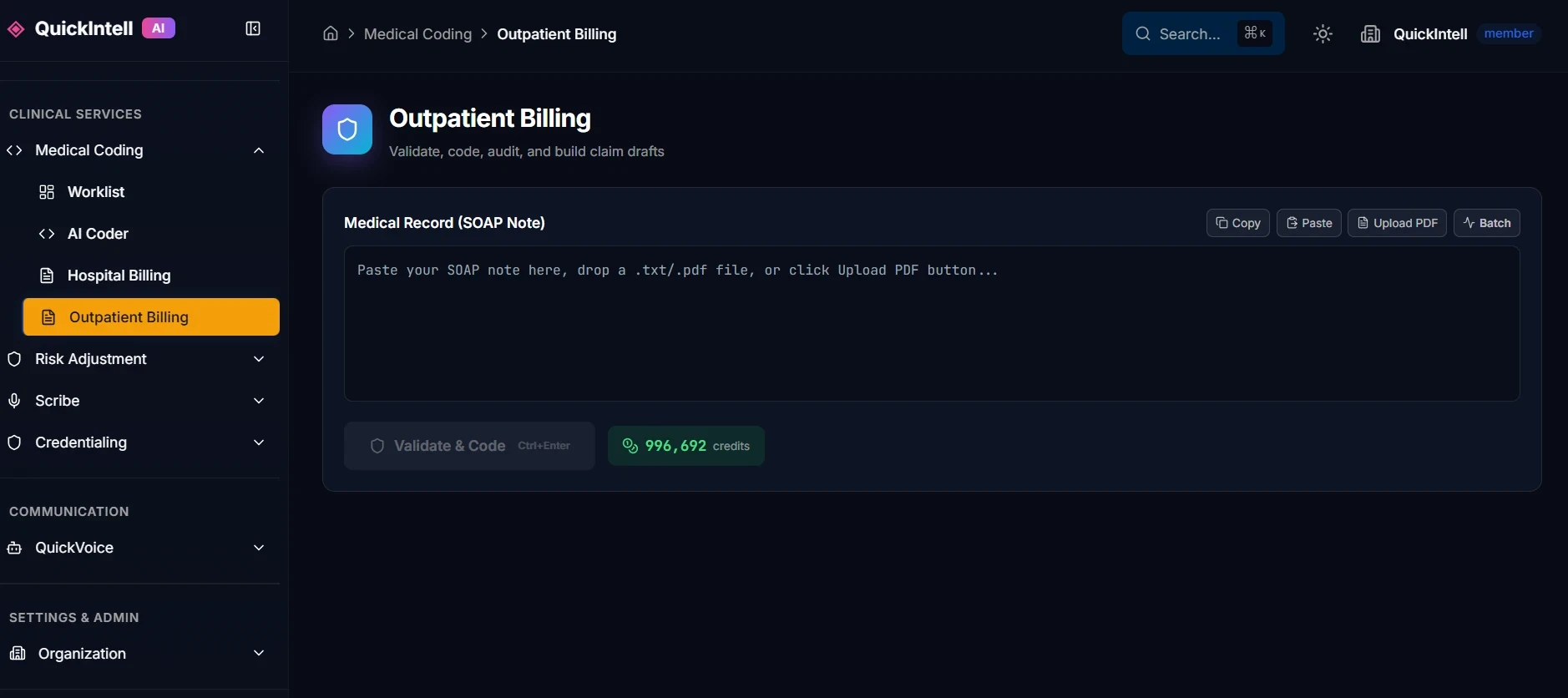
Accepted code lines move into the outpatient billing claim editor only after blocking scrub findings are cleared or overridden with a reason.
Clean coded claims are ready for Claims submission.
EHR write-back
Finalized codes flow downstream to Claims and write back to the EHR encounter with the extraction, edits, clarifications, and overrides logged.
The source encounter keeps the complete coding audit trail.
Key Features
Revolutionizing medical coding with AI-driven precision and efficiency.
⚡Real-Time Coding
Deliver coding results instantly to accelerate billing cycles.
💰Cost Savings
Reduce overall coding operations costs by up to 50%.
🎯High Accuracy
Instantly cut down on claim denials and lower audit risks.
⏱Unmatched Speed
Slash turnaround times by days instead of hours.
📈Seamless Scalability
Effortlessly handle millions of charts per day.
🔐Advanced Security
Protect PHI with HIPAA-compliant, industry-leading security protocols.
Why Choose Us
Discover how QuickIntell leads the way in medical coding innovation.
8-12% Higher Reimbursement per Encounter
Improve level-of-service and modifier capture so more earned revenue reaches the claim.
92%+ First-Pass Coding Acceptance
Move from a typical 70-80% baseline within 90 days as coders review AI-suggested code sets.
Coding Denials Under 1.5%
Reduce coding-driven denials from a typical 4-7% of claims, with NCCI/MUE denials below 0.5%.
HIPAA-Compliant Audit Trail
Capture every extraction, edit, override, and clarification answer for compliance review.
3-4 Minutes per E/M Encounter
Cut coder time from a typical 8-12 minutes per outpatient E/M encounter, reducing coder hours by 30-50% per chart.
94%+ HCC Capture
Capture identified Medicare Advantage and risk-adjustment opportunities with human review controls preserved.
What Powers Our Technology
QuickIntell's AI-powered coding engine combines advanced automation with clinical intelligence to deliver unmatched accuracy, speed, and compliance.
AI & Machine Learning
Continuously trained on vast medical datasets for smarter, faster coding.
Clinical Knowledge Graph
Maps complex medical terminology to ICD, CPT, and HCPCS standards with precision.
EHR Integration
Connects seamlessly with leading EHR systems for real-time data population.
Built-In Compliance
HIPAA-compliant and aligned with regulatory requirements from day one.
Scalable Infrastructure
Designed to handle millions of charts daily without performance drops.
Enterprise-Grade Security & Seamless Integration
Built for Healthcare's Strictest Requirements
Unmatched Security
- • HIPAA & SOC2 Type II certified
- • End-to-end encryption for all patient data
Universal EHR Compatibility
- • Works with Epic, Cerner, ECW, and 100+ other systems
- • FHIR/HL7 standards for seamless interoperability
Real-Time Sync
- • Automatic bidirectional updates
- • Zero disruption to clinical workflows
Data Governance
- • HITECH, GDPR, and CCPA compliant
- • Transparent handling of sensitive health data
Innovation Partnerships
- • Powered by NVIDIA Inception & Microsoft
- • Future-ready for scalable healthcare solutions
Frequently Asked Questions
About Medical Coding