
EHR Integration
Bring appointments, coverage, attested notes, orders, and charge details into the revenue workflow, with field mappings, sync logs, and conflict review before write-back.
Explore EHR IntegrationInfectious disease revenue cycle software
Connect OPAT, infusion, consult, and chronic-infection billing work without removing the human review your team needs.
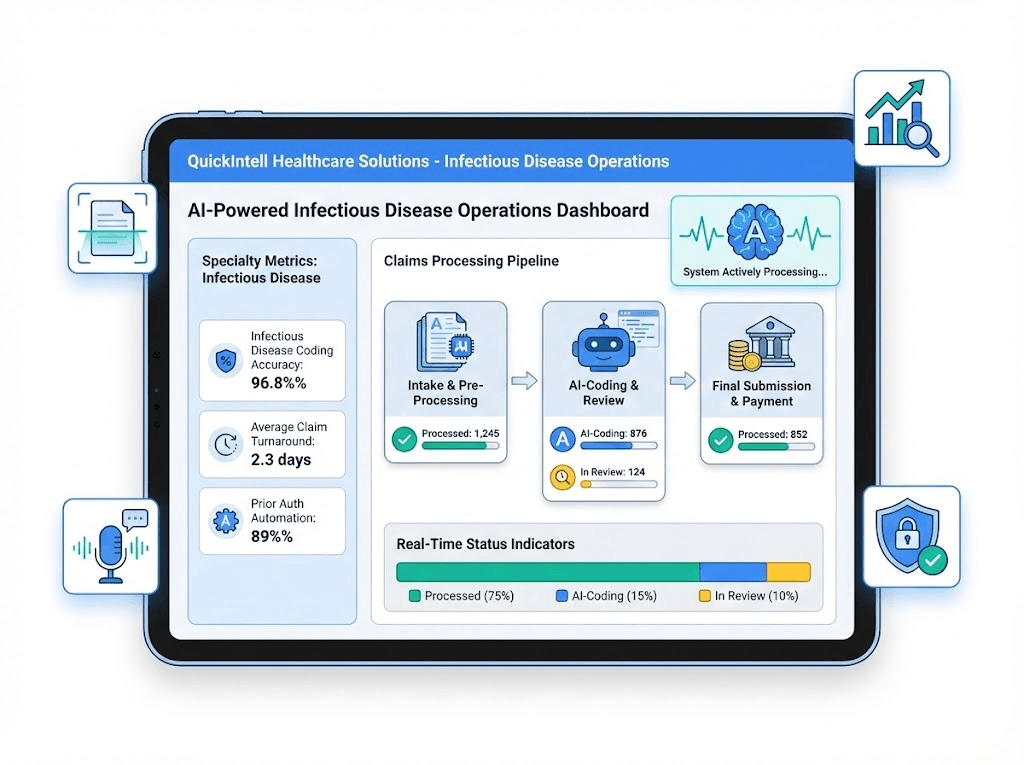
QuickIntell brings EHR documentation, authorization evidence, charge details, coding suggestions, claim checks, and payer follow-up into one traceable workflow. Coders, billers, and clinicians can review exceptions before anything moves forward.

TL;DR
Trust and security review
Validate the deployed access model, data flow, retention, and contract requirements with your security and legal teams during procurement.
The workflow connects specialty context to existing revenue cycle functions. Automation prepares and checks the work; authorized staff still make the clinical, coding, and release decisions.
Bring appointments, coverage, attested notes, orders, and charge details into the revenue workflow, with field mappings, sync logs, and conflict review before write-back.
Explore EHR IntegrationCreate reviewable drafts from coverage, diagnosis, planned codes, service date, units, site of care, and supporting clinical evidence, then track payer status and renewals.
Explore Prior AuthorizationPropose E/M, CPT or HCPCS, ICD-10, and modifier candidates from attested documentation. Coders can accept, edit, or request clarification before codes continue.
Explore Medical CodingReview encounter-note drafting with QuickScribe. Clinicians verify the source record and attest the note before it continues into coding or billing work.
Explore Clinical DocumentationReview documented diagnoses, supporting evidence and applicable risk-adjustment rules with coder and provider oversight; a suggested condition still requires validation.
Explore HCC Risk AdjustmentReconcile documented infusion, drug, supply, and consult services to charge lines; flag missing mappings, units, or service details for an analyst to resolve.
Review OPAT and infusion billing contextCheck authorization, NCCI and MUE edits, medical necessity, bundling, documentation, and modifiers before a claim is released, with findings routed to a reviewer.
Explore Denial PreventionBuild the payer-ready claim, route it through the configured clearinghouse, track acknowledgments and status, and return updates to the connected record.
Explore ClaimsKeep reason codes, claim context, supporting evidence, ownership, deadlines, and resolution work together when a payer does not adjudicate as expected.
Explore Denial ManagementReview authorization, coding, claim, denial, and accounts-receivable patterns by payer or workflow, then drill back to the source record for follow-up.
End-to-end workflow
Each checkpoint keeps its source evidence, current owner, and next action visible so an exception can be reviewed without rebuilding the case in another spreadsheet.
Bring the appointment, coverage, order, and attested clinical record into a traceable work item.
Check benefits and payer criteria, assemble supporting evidence, and send missing information to the right owner.
Compare documented services with diagnosis, procedure, drug, unit, modifier, and site-of-care details.
Route low-confidence suggestions, documentation gaps, or rule conflicts to a coder, biller, or clinician.
Complete pre-submission checks, transmit the claim, and watch acknowledgments and payer status.
Assign denials and follow-up, track patient-responsibility handoffs, and use recurring patterns to improve the queue.
Infectious disease billing often depends on evidence spread across orders, cultures, medication history, infusion records, consult notes, and payer responses. Review the OPAT and infusion billing context when defining those handoffs. QuickIntell can organize and check that work, but qualified staff remain responsible for coding, clinical clarification, approval, and claim release.

Low-confidence code suggestions and missing documentation can be sent back with a structured question before the encounter continues.
Missing payer evidence, partial decisions, pended cases, and approaching service dates remain visible to an authorization specialist. The payer controls the final decision.
A biller reviews failed checks and warnings, applies an approved correction or documented override, and decides when the claim is ready to submit.
Edits, approvals, overrides, payer updates, and assignment changes retain an audit trail for operational and security review.
Human approval gates
Configured by workflow and role
Source-linked review
Evidence, decision, owner, and next action
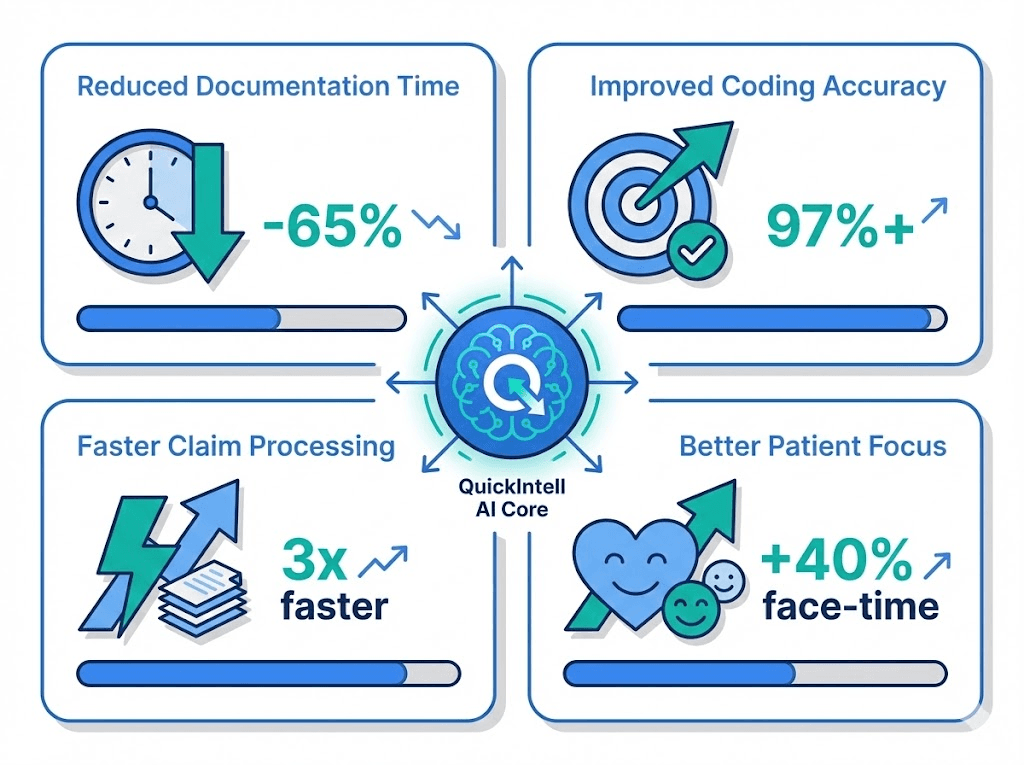
Choose which findings can continue, which require approval, and which pause the workflow.
Assign authorization, coding, billing, clinical clarification, and denial work to accountable roles.
Define what happens when evidence is missing, a payer response is late, or a system sync needs intervention.
Start with visible review and expand automation only after your team validates the configured behavior.
Buyer and implementation guide
General billing tools can store a claim, but infectious disease teams also need to preserve the clinical and payer context behind OPAT, infusion drugs, consults, and longitudinal therapy. Evaluate the workflow by what a reviewer can verify, not by an automation claim alone.
The work item should keep the order, diagnosis, drug and units, site of care, infusion details, relevant note, authorization status, and payer response together.
Authorization, coding, charge review, claim checks, status, denial work, and patient-balance handoff should not require separate spreadsheets to reconstruct the case.
Reviewers should be able to see the source, edit a suggestion, request clarification, document an override, and identify who approved the next action.

Start with a bounded pilot
One payer, site, or service line
Keep approvals visible
Validate before increasing automation
Scope, access, review behavior, and escalation ownership should be agreed before production automation is enabled.
Document sites of care, payers, high-friction services, EHR sources, current handoffs, and escalation owners.
Define field mappings, write-back scope, user roles, approval rights, and the security evidence your organization must review.
Start with a bounded payer, location, or service line and require staff approval while your team validates suggestions, routing, and sync behavior.
Review queue volume, overrides, sync exceptions, payer responses, and denial patterns before changing thresholds or widening scope.
Practical answers about ID coding context, OPAT and infusion claims, payer authorization, human review, EHR integration, patient billing, security, and implementation.
ID claims often depend on context that lives in several places: site of care, medication history, culture or lab evidence, route and duration, infusion administration, drug HCPCS and NDC details, units, consult documentation, and authorization status. A useful workflow keeps those inputs connected to the charge, code, and claim so a reviewer can verify the source instead of rebuilding the case.
The exact code set depends on the documented service, service date, setting, and payer. Reviewers may need to validate E/M and applicable add-on codes such as G0545, infusion-administration codes, drug HCPCS and NDC units, ICD-10 diagnosis specificity, modifiers, place of service, authorization, and attachment requirements. QuickIntell can surface candidates and rule findings, but a qualified coder should verify current-year code and payer guidance before submission.
The workflow can keep the order, therapy dates, site of care, drug and units, line or nursing details, authorization, relevant note, and payer response on one case. Charge and coding checks can then flag missing or conflicting details for an analyst or coder rather than silently treating them as complete.
QuickIntell can prepare a reviewable authorization draft using coverage, diagnosis, planned codes, service date, requested units, route, duration, prior-therapy history, and supporting clinical evidence. Staff validate and submit the packet, monitor status, and handle requests for more information. Approval and response time remain with the payer.
Your organization defines the review gates. Coders can accept, edit, or reject code suggestions; clinicians can answer clarification questions; authorization staff can resolve missing evidence; and billers can address claim findings or document an approved override. Automation should not be treated as a substitute for professional coding judgment or payer-specific review.
QuickIntell can exchange patient, appointment, coverage, attested note, charge, finalized code, claim-status, payment, and statement data with a configured EHR connection. Implementation includes field mapping, write-back scope, access setup, sync logs, conflict handling, and a bounded validation pilot; available data and behavior depend on the EHR and deployment scope.
When patient billing is included in scope, adjudicated patient-responsibility balances can continue into statement, payment-plan, receipt, and follow-up workflows, with balance and payment updates written back to the connected record. The practice controls statement rules, assignments, approvals, and escalation policies.
Product documentation describes role-based permissions, organization-level data isolation, encrypted data paths and credentials, and audit logs for workflow actions. Your security and legal teams should confirm the deployed architecture, access model, retention, contract terms, and required evidence during procurement rather than relying on a page claim alone.
A practical rollout maps the current OPAT, infusion, consult, claim, denial, and patient-balance processes; identifies source systems and queue owners; configures integrations, roles, payer rules, and approval gates; then pilots a bounded workflow with visible human review. Scope should expand only after the team validates routing, suggestions, overrides, and sync behavior.
Have a workflow question that is specific to your payers, sites, or EHR?
Discuss your ID billing workflowInfectious disease workflow planning
Tell us which handoff creates the most rework. We will use your practice profile to prepare a focused discussion about source data, review gates, owners, and implementation scope.
You can also contact our team or email info@quickintell.com.
Infectious disease workflow review
Bring a de-identified outline of the workflow that creates the most rework. QuickIntell can help your team identify source data, review gates, owners, integration points, and a practical pilot boundary.

No PHI needed for discovery
Start with roles, systems, steps, and exceptions
CMS coding and coverage reference
In the CMS NCCI practitioner and ASC procedure-to-procedure table, version v323r0 (2026 Q4), 345 codes in the infectious disease ranges listed below are column one in 4,425 active pairs, and 77% of those pairs carry modifier indicator 1, so an NCCI-associated modifier can bypass the edit when the record supports a distinct service. The hospital outpatient table holds 4,391 pairs for the same codes. The 2026 Q4 practitioner Medically Unlikely Edit table sets a value for 364 codes in these ranges, all of them applied per date of service, and 260 of the values allow a single unit. 15 codes in the ranges are add-on codes that must be billed with a primary procedure. The most frequent edit rationale is “CPT Manual or CMS manual coding instruction” (1,960 pairs).
Code ranges counted: 87003-87999 (microbiology); 96360-96379 (hydration, infusions and injections); 90460-90749 (immunization administration and vaccines); G0008-G0010 (flu, pneumococcal and hepatitis B vaccine administration). The ranges are our selection of where infectious disease services sit in the code set, not a CMS classification.
A screening culture and a definitive identification culture are not reported together for the same specimen and day, and testing one organism from one site by more than one method is paid once, with one exception the chapter names. Nucleic acid probe codes include all the molecular analyses they need.
Each code is the column-two code in this many active practitioner pairs whose column-one code is also in the ranges. Open one in the NCCI checker to see its pairs and modifier indicators.
Sources: CMS Medicare NCCI Policy Manual (2026 edition) and the quarterly NCCI procedure-to-procedure, Medically Unlikely Edit and add-on code files, edit version v323r0 (2026 Q4) effective 2026-10-01; counts computed by QuickIntell from those files, see the methodology. CPT codes are shown as numbers only; CPT is a registered trademark of the American Medical Association. A summary for orientation, not billing or legal advice: check the CMS text and your Medicare Administrative Contractor before you code.