Accurate, defensible RAF capture for MA plans, ACOs and risk-bearing providers — without manual chart chasing.
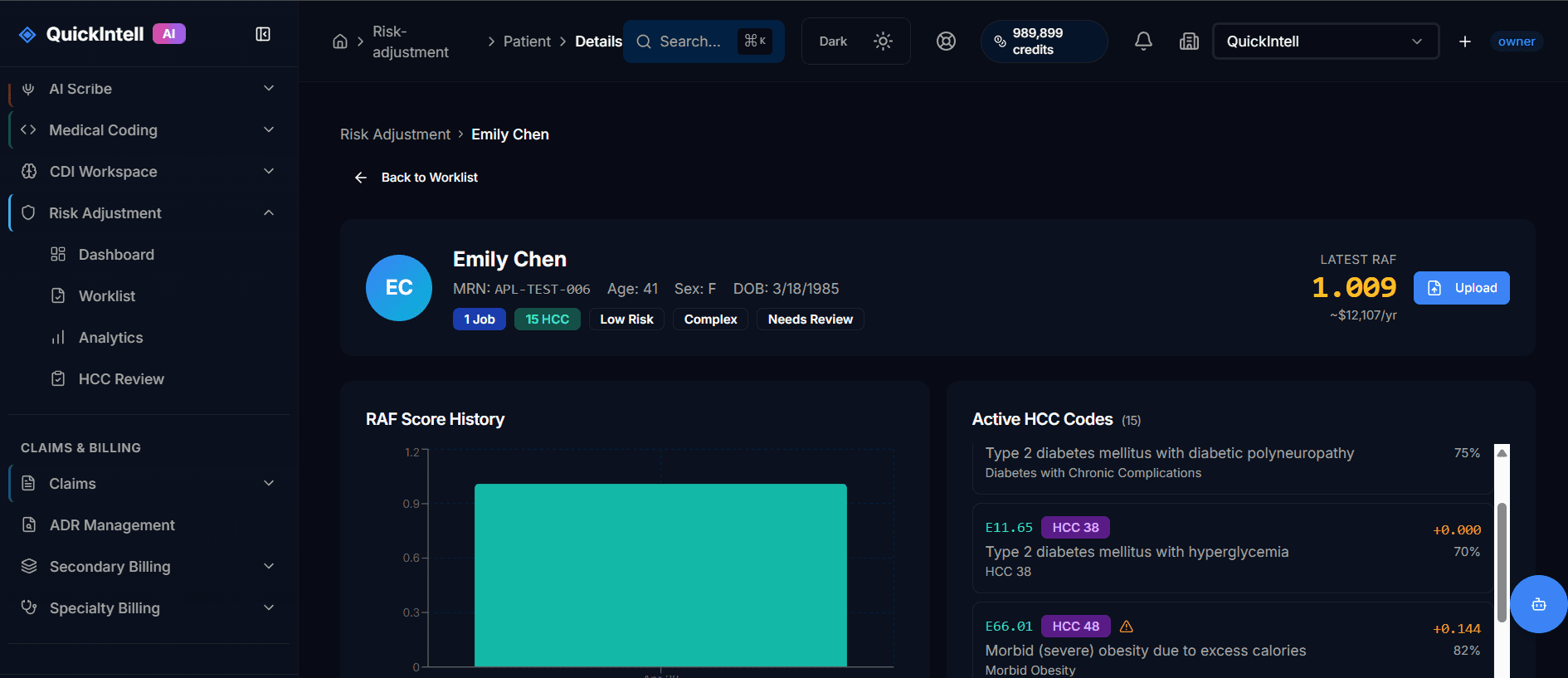
Score every encounter against CMS-HCC v22/v24/v28 in under 15 seconds, with NPI-signed clinical review and CMS-submission-ready RAPS/EDPS files.
+2.7% average RAF lift on 1.9M encounters • −58% manual chart hours • Audit exceptions −82% • HCC denials −34%
TL;DR
AI HCC Coding in 30 seconds
A single-screen summary for RAF, clinical, and compliance teams evaluating the workflow.
What it does
Finds supported HCC gaps from notes, diagnoses, labs, claims, and problem lists, then routes evidence-linked suggestions for coder and provider review.
Models covered
Supports CMS-HCC v22, v24, and v28, ESRD-HCC cohorts, and RxHCC scoring for Medicare Advantage and risk-bearing populations.
Audit story
Keeps source snippets, model version, hierarchy decisions, MEAT evidence, reviewer sign-off, and exportable packets tied to every capture.
Outcomes
Targets higher RAF accuracy, fewer manual chart hours, lower HCC denial exposure, and faster recapture worklists without over-coding.
You're stuck with missed conditions, inconsistent documentation, and slow, manual chart sweeps. It costs hours of coder time, preventable denials, compliance exposure, and under-captured RAF across panels.
What it's costing you (typical):
- •40–60% of coder time lost to low-value chart review
- •3–7% RAF under-capture on complex panels
- •Avoidable audit risk from over-coding & poor traceability
Here's the simple way: AI HCC Coding ingests structured & unstructured clinical data, auto-surfaces candidate HCCs with evidence links, and guides coders/providers to confirm, document, and close gaps so you get accurate RAF per encounter with audit-ready transparency.
Benefits
Transform your HCC coding workflow with AI that delivers measurable results from day one.
>95% precision & recall on HCC suggestions
So you cut false positives and reclaim coder capacity (up to 60% fewer manual reviews).
Systematic gap closure
So you reduce under-/over-coding and lift RAF where clinically appropriate (2–5% RAF improvement on targeted cohorts).
Audit-ready traceability
So you pass audits with confidence (source-of-truth citations, versioned evidence, coder/provider attestations).
How It Works
Get started with AI HCC Coding in four simple steps
Connect
Securely connect EHR/PMS and data lakes via FHIR & proprietary APIs (notes, problem lists, meds, labs, claims).
Configure
Choose HCC model (e.g., CMS-HCC V28), workflows, thresholds, routing, and attestation rules.
Run
The engine parses notes & data, proposes HCCs with supporting snippets, and routes to coder/provider for one-click confirmation.
Measure
Dashboards show RAF lift, gap closure, coder throughput, and audit trails—export to BI or feed back to EHR.
Proven Outcomes & ROI
Real results from organizations using AI HCC Coding (rolling 6–12 months across 11 deployments, 1.92M encounters analyzed)
Average RAF Lift
Panel RAF across 1.92M encounters (IQR 1.9–3.5%)
Manual Chart Review
Coder hours for initial sweeps
HCC Denials
Within 90 days post-go-live
Coder Throughput
Charts/hour (baseline 12.6 → 17.8)
Precision & Recall
On HCC suggestions
Audit Exceptions
QoQ reduction
Source: 11 deployments, 1.92M encounters, rolling 6–12 months, anonymized customer aggregate. Methodology available on request.
Top Clinical Gains (PPV/Recall)
CHF (HCC 85/86)
PPV 96.8% / Rec 95.9%
n=38k
COPD (HCC 111)
PPV 95.1% / Rec 94.0%
n=27k
CKD (HCC 136–138)
PPV 97.2% / Rec 95.0%
n=31k
Diabetes w/ complications (HCC 18/19)
PPV 96.5% / Rec 96.1%
n=52k
Performance by Workflow
Initial Risk Sweep
- • −54% hours
- • Precision 95.6%
- • Recall 95.1%
Annual Recapture
- • −62% hours
- • Precision 96.2%
- • Recall 94.8%
Pre-Encounter Gap Prompt
- • Show rate 83%
- • Provider attestation acceptance 72%
Vendor comparison
Why QuickIntell vs. retro chart-review vendors
Retrospective review still matters, but risk teams capture more defensible value when gap prompts reach coders and providers before the chart becomes stale.
Manual batch review
Retro chart sweep
- Starts after encounters are already closed.
- Depends on chart sampling, coder capacity, and year-end rushes.
- Evidence packets often need separate assembly before audit response.
Embedded lookup
In-EHR retro tools
- Useful for retrospective gaps inside a single chart workflow.
- Usually constrained by one EHR data model and limited cross-payer context.
- Provider action still happens late, after documentation habits are set.
Point-of-care plus sweep
QuickIntell prospective + retro
- Surfaces gaps before and after encounters with evidence and hierarchy logic.
- Routes coder, CDI, and provider attestations with reviewer controls.
- Pre-Encounter Gap Prompt: Show rate 83%, Provider attestation acceptance 72%.
Models & Submissions
Every CMS risk model. Every submission window. Audit-ready.
Configure the right model family for each line of business, generate compliant RAPS and EDPS files, and enforce CMS submission deadlines with MEAT-validated evidence on every diagnosis.
CMS-HCC
Medicare Advantage (Part C)
v28 normalization factor 1.000 applied for PY 2026 (3-year blended phase-in complete).
ESRD-HCC
End-Stage Renal Disease enrollees
Dialysis & post-graft cohorts with model-specific community/institutional segments.
RxHCC
Part D prescription drug benefit
Concurrent Rx risk scoring for Part D bid and reconciliation cycles.
Submission, validation & reviewer workflows
RAPS file generation
Builds Risk Adjustment Processing System claim records (CCC/CME formats) with header, trailer, and HICN/MBI handling.
EDPS encounter submission
Generates compliant 837-I/837-P encounters for the Encounter Data Processing System with diagnosis linking and corrected/voided submission flows.
CMS submission-window enforcement
Enforces Initial, Mid-Year, and Final Sweep deadlines (Q1/Q3/Q1+13mo) with auto-lock, late-add quarantine, and reopen-window controls.
MEAT-criteria reviewer flow
Coder/CDI workflow validates Monitor, Evaluate, Assess, Treat evidence per chronic condition before HCC capture is finalized.
Reconciliation & error response
Ingests MAO-002, MAO-004, and 277CA reports to triage rejections, duplicates, and disallowed diagnoses with corrective resubmission.
Audit & traceability binder
Versioned evidence snapshots tie every submitted diagnosis back to source documentation, MEAT attestation, and reviewer sign-off.
Feature Groups
Comprehensive capabilities that power your HCC coding workflow
Automate
- AI extraction across SOAP notes, PDFs, CCDA, labs & claims to proposed HCCs with evidence highlights
- Real-time gap detection (suspect conditions, recapture needs, documentation insufficiency)
Collaborate
- Coder-assist queueing, provider attestations, and CDI handoffs with in-app commentary
- Role-aware tasks: coder → provider → compliance with SLAs & reminders
Control
- Policy engine for CMS-HCC versions, local edit sets, and organization-specific coding guidelines
- Fine-grained RBAC, approval thresholds, dual-review for high-risk categories
Report
- RAF lift, gap closure rates, coder productivity, denial trends, and audit outcomes
- Evidence packs: versioned snapshots, data lineage, and exportable audit binders
Integrations
Works with: Epic, Cerner, Athenahealth, eClinicalWorks, Meditech, OpenEMR, NextGen, Allscripts; plus clearinghouses/EDIs and data warehouses.
Supported EHRs & Systems
Enables:
FHIR-native ingestion
FHIR-native ingestion of encounters, problems, meds, labs, and documents
EHR write-back
Write-back of confirmed codes/documentation to EHR problem lists/encounters
BI feeds
BI feeds to Snowflake/BigQuery/Redshift for enterprise analytics
Denial feedback loops
Denial feedback loops from 835/277 for continuous model tuning
Security & Compliance
Enterprise-grade security and compliance built into every aspect of our platform
End-to-end encryption (in transit & at rest), SSO/MFA, least-privilege RBAC, field-level access controls, audit logging, immutable evidence packs. HIPAA-compliant, SOC 2 Type II certified, BAA included. Data residency & VPC/private-link options available.
Compliant & BAA included
Type II certified
Uptime SLA
Where to go next
Related products
Risk Adjustment connects with upstream documentation, coding, claims, and the teams that manage payer and provider risk programs.
QuickCode
Medical Coding feeds the validated ICD-10 set that Risk Adjustment turns into HCC and RAF outputs.
Learn moreQuickScribe
Clinical notes upstream give QuickCode and HCC reviewers the encounter evidence they need.
Learn moreQuickRCM
Claims workflows receive finalized HCC and RAF outputs for Medicare Advantage submission.
Learn moreSolutions for payors
Operationalize gap closure, audit response, and payer risk programs across covered lives.
Learn moreSolutions for providers
Help risk-bearing groups and ACOs capture clinically supported RAF without extra chart work.
Learn morePricing
Choose the plan that fits your organization's needs. All plans include core AI HCC suggestions and RAF optimization.
for boutique groups & pilots
- Up to 10k encounters/mo, 5 seats, 1 environment
- Core AI HCC suggestions, coder-assist, evidence links
- Email support, shared SLA
for multi-clinic ACOs/MSOs
- Up to 50k encounters/mo, 25 seats, 2 environments (dev/prod)
- Advanced gap analytics, provider attestations, custom rules
- SSO/MFA, priority support, quarterly optimization review
for payers & large IDNs
- Unlimited encounters (volume-tiered), unlimited seats, multi-env
- Enterprise RBAC, audit packs, data lake & EDW connectors, BAAs
- Dedicated CSM, 99.9% uptime SLA, enterprise onboarding
Add-ons Available
Custom NLP packs, on-prem/VPC deployment, enhanced PHI redaction, premium analytics.
Frequently Asked Questions
Get answers to common questions about AI HCC Coding.
Ready to achieve accurate, defensible RAF at scale?
Join 180+ healthcare organizations already using AI HCC Coding to maximize RAF accuracy, reduce denials, and improve revenue integrity.