Verify Pre-Visit Coverage and Write Results Back to the EHR
QuickIntell runs nightly batch sweeps across tomorrow's schedule, supports walk-in checks in seconds, routes 270 requests through Availity or Stedi, parses 271 responses for copay, deductible, and out-of-pocket details, then writes verified coverage back to the EHR.
Buyer TLDR
Verify before visit
Run single checks and nightly batch sweeps with QuickIntell Eligibility before next-day appointments.
Prevent eligibility denials
Catch inactive coverage, stale checks, and payer rejects before claims go out.
Reduce patient-access rework
Write verified copay, deductible, and OOP details back to the EHR so staff redo fewer coverage checks.
How Eligibility Actually Runs
Every check starts from the appointment context, follows one payer-routing path across QuickIntell integrations, and writes the verified result back where front-desk teams already work.
EHR appointment trigger
A scheduled visit supplies patient, coverage, service date, and provider details from the EHR.
Single check
Walk-ins and same-day changes can be verified on demand in seconds from the eligibility dashboard.
Nightly 2 AM batch
QuickIntell sweeps the next-day schedule automatically and queues one check per appointment.
Availity or Stedi 270/271
The routing engine sends the 270 through Availity or Stedi and parses the payer's 271 response.
Verified badge
Parsed benefits update copay, deductible, and OOP fields, then write a Verified badge back to the EHR.
The Challenge of Manual Eligibility Verification
Verifying patient eligibility and benefit details is a time-consuming and labor-intensive process that significantly impacts healthcare Revenue Cycle Management. Despite the effort invested, manual eligibility verification creates multiple challenges:
High Denial Rates
Eligibility errors drive about 24% of initial claim denials, making coverage mistakes a major front-end risk
Financial Impact
Eligibility-related denials cost $25-$118 to rework before staff can recover the claim
Resource Intensive
Manual verification processes consume valuable staff time and resources

QuickIntell's AI-Powered Eligibility Verification Solution
Our advanced AI-powered eligibility verification solution transforms your Revenue Cycle Management by automating complex verification processes. This intelligent system allows healthcare providers to focus on patient care while ensuring accurate insurance verification and benefit validation. With our powerful AI technology, you can:
Prevent more rejections and denials
Identify coverage issues before claim submission
Strengthen frontend collections
Improve cash flow with accurate benefit information
Optimize staff productivity
Automate manual verification tasks
Elevate the patient payment experience
Provide transparent, accurate cost estimates

ELIGIBILITY BY THE NUMBERS
Our solution has delivered impressive results:
Reduced from 20-35 hours/week on eligibility calls and portals
Eligibility-driven denials down from 11.6% in one quarter
Pre-visit coverage rate within 90 days
Time-of-service collection accuracy
How QuickIntell's AI-Powered Eligibility Verification Works

Our solution leverages advanced AI algorithms and machine learning to analyze vast amounts of payer data, providing accurate and comprehensive benefit information. With our technology, you can:
Automate eligibility verification in real-time
Identify coverage and verify eligibility with expansive payer connectivity
Normalize payer data for more actionable, efficient workflows
Receive intelligent alerts with actionable guidance for staff
Benefits of QuickIntell's AI-Powered Eligibility Verification
Substantial Cost Savings
Reduce administrative costs by automating manual and repetitive tasks.
Reduced Denials
Improve first-pass claim acceptance rates with AI-powered accuracy.
Improved Revenue Recovery
Capture more billable services and optimize reimbursement.
Enhanced Compliance
Ensure robust compliance with critical healthcare regulations.
Real-World Results
Our solution has delivered significant results for healthcare organizations, including a 72% reduction in administrative costs and an 85% decrease in processing time.
Reduction in administrative costs
Decrease in processing time
Streamlined Eligibility Verification Workflow
Our AI-powered eligibility verification process transforms complex manual workflows into efficient automated systems:

1. Data Capture
Automated extraction of patient and insurance information from multiple sources

2. AI Processing
Real-time analysis and verification using advanced machine learning algorithms

3. Integration
Seamless integration with EHR systems and automated result delivery
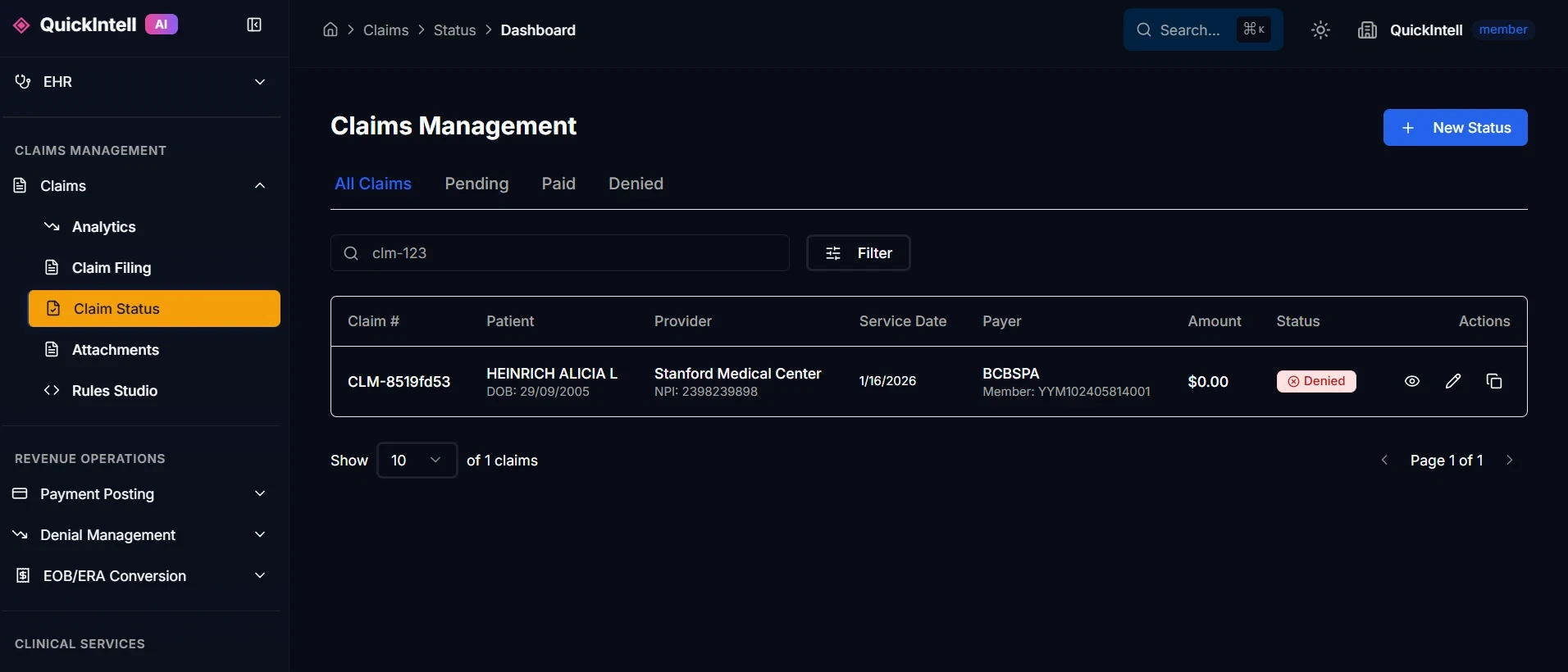
Eligibility Status Model
Each payer response lands in a clear operating state so patient access teams know the next action before check-in.
Coverage is in effect for the service date.
Next action: Save and notify the front desk; collect the listed copay.
The plan ended or is not valid for the visit date.
Next action: Contact the patient or mark self-pay after confirmation.
The check started but no payer answer has returned.
Next action: Wait briefly, then review Vendor Health if it remains open.
Transport failed, the payer is down, or vendors failed.
Next action: Retry once; use Schedule Auto-Retry during vendor outages.
The latest check is older than the freshness window.
Next action: Re-verify selected appointments before the visit date.
Staff manually marked verification despite a missing or failed check.
Next action: Require a documented reason and review override trends weekly.
The payer rejected the inquiry for bad ID, wrong subscriber, or another field issue.
Next action: Fix the coverage field identified by the AAA code, then retry.
Downstream Handoffs After Eligibility
Verified eligibility data feeds the rest of the revenue cycle instead of staying trapped in a response viewer.
Prior Auth
Active coverage and auth flags help QuickAuth determine whether a planned service needs pre-approval before the claim is created.
Patient AR
Copay, deductible, and out-of-pocket details update patient responsibility estimates for check-in collection.
Insurance Discovery
Inactive coverage can mark a patient self-pay and queue Insurance Discovery for hidden Medicaid, commercial, or other active coverage.
Claims
Verified payer IDs and coverage details flow into claims so the 837 carries cleaner payer data before payment posting reconciles ERA outcomes.
GFE
Plan and out-of-pocket details support Good Faith Estimate workflows and No Surprises Act decisions.
EHR Integration
Verified status, eligibility history, and downstream write-backs sync through EHR integrations for chart-level visibility.
Advanced AI Technologies for Eligibility Verification
Our eligibility verification solution leverages cutting-edge AI technologies to deliver unparalleled accuracy and efficiency:
Computer Vision
Advanced document processing and data extraction

Machine Learning
Intelligent pattern recognition and prediction
OCR Technology
Accurate text recognition from various document types
Natural Language Processing
Understanding and processing healthcare language
Unlock Efficiency. Drive Growth. Enhance Care.
Ready to revolutionize your Revenue Cycle Management with QuickIntell's AI-powered eligibility verification solution? Customers report cutting eligibility phone calls and portal work from 20-35 hours/week to 3-5, reducing eligibility-driven denials from 11.6% to 2.8%, and reaching 96%+ pre-visit coverage. Contact us today to schedule a personalized consultation and discover how our advanced AI agents can transform your healthcare operations.
Explore our comprehensive healthcare AI solutions or learn about our AI-powered eligibility verification, or review HIPAA, audit logging, and BAA coverage in the Trust Center. Visit us at quickintell.com or email us at info@quickintell.com
Frequently Asked Questions About AI-Powered Eligibility Verification
It confirms whether coverage is active for the service date and returns payer-reported plan, copay, deductible, out-of-pocket, and notes so staff can save the verified result back to the EHR.
Staff can run a single check for walk-ins or same-day changes. The nightly 2 AM batch sweeps the next-day schedule, reads patient and coverage details from the EHR, and queues one eligibility check per appointment.
The routing engine selects Availity or Stedi based on payer capability, sends a 270 request, and parses the payer 271 response into status, financials, and notes.
Save and notify the front desk, collect the listed copay, and rely on the EHR verified badge and eligibility history for downstream work.
INACTIVE should be confirmed before marking self-pay or contacting the patient. STALE should be re-verified. ERROR should be retried or scheduled for auto-retry if vendors are down. PENDING should be allowed a short wait and then checked against Vendor Health if it does not complete.
Use the AAA code to find the cause, compare member ID and subscriber details to the card and coverage record, fix the underlying field in the EHR or coverage record, then retry.
Active coverage and auth flags support prior authorization, copay and deductible data support Patient AR, inactive coverage can queue Insurance Discovery, verified payer IDs support claims, and plan/OOP details support GFE workflows.
Yes. PHI is encrypted at rest and in transit, eligibility actions are audit logged, access is controlled with RBAC, tenant data is isolated by organization, and BAAs are maintained with covered Business Associates such as Availity and Stedi.