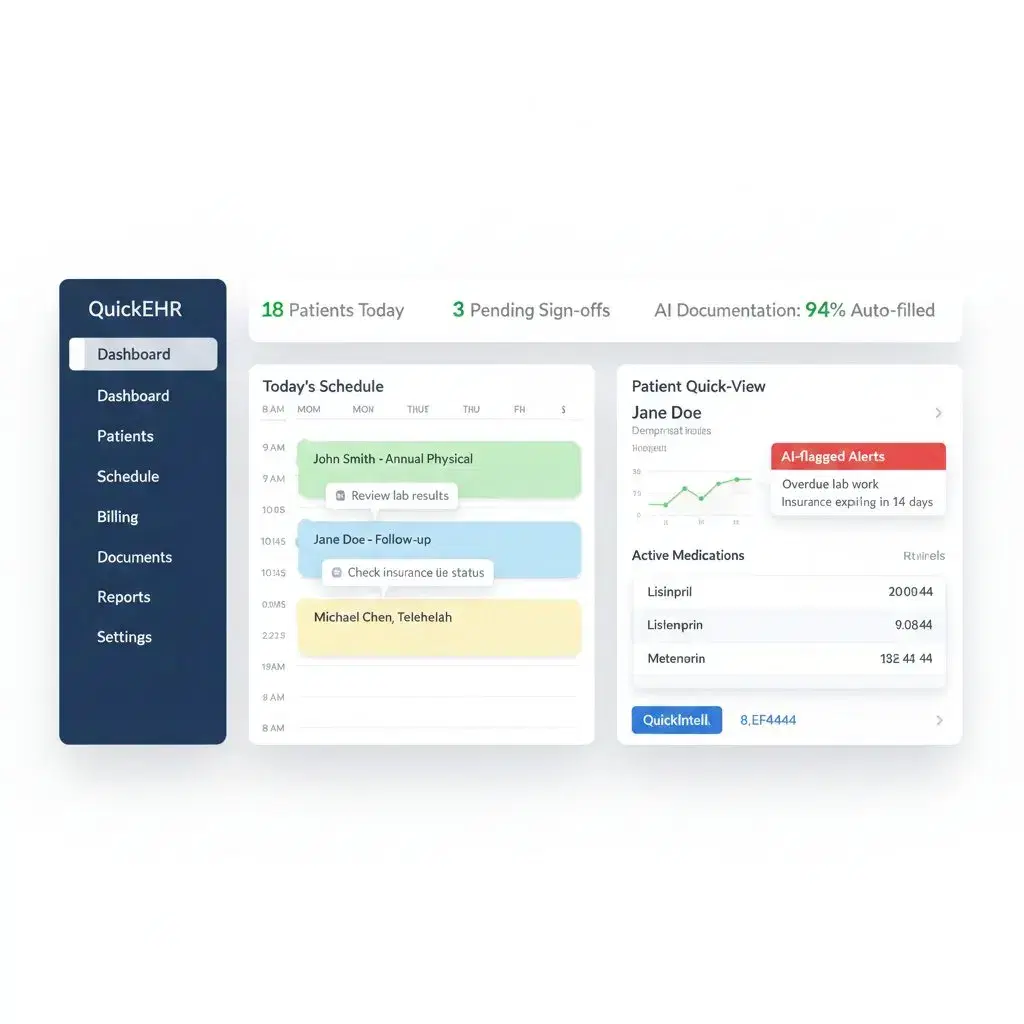
Period close automation for QuickEHR billing workflows
QuickEHR period close automation helps billing teams close end-of-day and month-end medical billing periods with OpenEMR-powered reconciliation, AI-assisted close review, charge and claim visibility, QuickERA remittance context, QuickRCM follow-up queues, and explainable close packets.
Close checklist, reconciliation, exceptions, owners
Close prep
Notes, charges, claims
Reconcile
ERA, payments, AR
Close
Packet, notes, reopen
Period close workflow
Close the billing period without losing the clinical and revenue cycle context.
A practical medical billing period close has to reconcile charges, payments, adjustments, denials, AR, and patient balances at day-end or month-end. QuickEHR keeps that close process tied to the EHR workflow that produced the work.
Close readiness
Prepare the close queue
QuickEHR period close automation starts by showing which encounters, charges, eligibility exceptions, authorizations, documentation gaps, coding questions, claims, payments, and balances still need attention before a period can be closed.
Group end-of-day and end-of-month close work by provider, location, payer, owner, status, and exception type.
Keep visit, chart, coverage, authorization, code, charge, claim, ERA, denial, and patient balance context visible in the close worklist.
Separate ready-to-close work from missing-note, missing-code, missing-auth, rejected-claim, posting, denial, and AR blockers.
Reconciliation
Reconcile charges, payments, and adjustments
Medical billing period close depends on more than a date filter. QuickEHR helps teams review charges, claim status, ERA/EOB payment posting, contractual adjustments, patient responsibility, write-off review, and unresolved exceptions before reporting.
Compare posted charges, submitted claims, remittance lines, adjustments, patient payments, and outstanding balances against the selected close window.
Use QuickERA context for ERA, EOB, underpayment, takeback, unapplied cash, payment variance, and posting exception review.
Carry unresolved items into QuickRCM queues so billers can close the period without losing follow-up ownership.
Close packet
Close, report, and reopen with control
Period close software should make the close explainable. QuickEHR supports close packets, checklist status, owner notes, exception summaries, reporting views, and controlled reopen planning for items that need correction after review.
Document close decisions with checklist evidence, unresolved exceptions, approved carry-forward items, and billing owner notes.
Use close summaries for provider, location, payer, procedure, denial, AR, payment, and patient balance review.
Define reopen rules and correction paths during implementation so post-close adjustments do not become undocumented workarounds.
Close controls
Period close software should make unresolved work visible before reporting.
QuickEHR period close workflows help teams distinguish closed work from carry-forward work. That matters when late charges, claim rejections, ERA posting exceptions, denials, AR, or patient balance issues would otherwise hide behind a monthly report.
Review same-day encounters, charges, missing notes, eligibility exceptions, payment collections, claim holds, and front-desk handoffs before the team leaves the daily queue.
End-of-month billing close
Coordinate month-end close in medical billing across open charges, pending claims, ERA/EOB posting, denials, AR, patient balances, and management reporting.
Encounter and charge review
Keep provider, location, place of service, diagnosis, procedure, modifier, unit, and charge context attached to the close item.
Coding and authorization blockers
Route coding questions to QuickCode and authorization evidence gaps to QuickAuth before they hold a claim, payment, or period report.
Claims and denial exceptions
Track rejected claims, corrected claims, claim-not-on-file responses, denied lines, attachment requests, and appeal tasks as close exceptions.
Payment posting readiness
Use QuickERA context to review remittance, contractual adjustments, patient responsibility, unapplied payments, underpayments, and posting variances.
AR carry-forward rules
Carry open payer AR, patient AR, appeal work, collection prep, and unresolved balances forward with owner, status, and next-action clarity.
Close packet and audit notes
Prepare a reviewable close packet with checklist status, exceptions, unresolved items, approvals, reopen notes, and reporting context.
AI EHR period close
AI can prepare the close, but the billing team keeps the decision points.
For practices comparing AI EHR period close, close management, or medical billing automation, QuickEHR uses QuickIntell workflows to classify blockers, summarize reconciliation, detect exceptions, and route work for review.
Close blocker classification
AI-assisted classification can group close blockers by missing documentation, coding review, authorization evidence, eligibility issue, rejected claim, posting exception, denial, AR follow-up, or patient balance question.
Reconciliation summaries
Draft concise summaries of what changed in the period: charges, claims, payments, adjustments, denial movement, AR exposure, patient responsibility, and unresolved close exceptions.
Variance and exception detection
Surface patterns such as unposted payments, mismatched adjustments, stale claims, late charges, missing authorizations, payer-specific rejection spikes, or locations with repeated close holds.
Owner routing and feedback loops
Route close work to billing, coding, authorization, front desk, provider review, payment posting, or QuickRCM queues, then use outcomes to improve the next close cycle.
OpenEMR and QuickEHR fit
OpenEMR period close depends on the interfaces and billing workflow your practice enables.
QuickEHR can be a managed OpenEMR-powered EHR or the workflow layer around an existing system. In either model, period close should know the chart, schedule, payer, authorization, charge, claim, denial, remittance, AR, and patient balance context.
QuickEHR is built on the OpenEMR foundation and adds QuickIntell-managed implementation, workflow configuration, and AI-assisted period close automation around billing operations.
Existing OpenEMR tenants
Practices already running OpenEMR can evaluate approved OpenEMR API, FHIR, HL7, EDI, clearinghouse, ERA, EOB, batch, or interface-engine paths for close context.
QuickEHR Connect around other systems
Clinics keeping another EHR or practice management system can evaluate QuickEHR as a workflow layer around documentation, coding, authorization, claims, payments, denials, and AR.
Related QuickIntell products
Period close sits at the end of the billing loop.
The close packet depends on documentation, coding, authorization, eligibility, claims, denials, AR, remittance, payment posting, patient balances, and reporting. These links keep buyers moving through the connected QuickIntell workflow.
Close rules differ when specialties have different authorization risk, documentation timing, payment variance, claim attachments, procedure complexity, and patient balance patterns.
Define close scope, review rules, and reopen controls before production use.
Period close workflows touch patient data, charge history, payer routing, coding decisions, authorization evidence, clearinghouse connections, remittance files, payment posting, patient balances, corrections, and reporting expectations. QuickEHR implementation should make review points and ownership explicit.
Security and procurement teams can review current materials through the Trust Center. Any implementation-specific evidence should be verified in the current contract and deployment packet.
Period close implementation checklist
Scope these items before go-live.
Define whether period close covers end-of-day close, end-of-month close, provider close, location close, payer close, accounting handoff, or all of those workflows.
Map close inputs: encounters, notes, charges, eligibility, authorizations, claims, rejections, ERA/EOB files, payments, adjustments, denials, AR, and patient balances.
Decide which items may close with carry-forward notes and which must be resolved before the billing period can close.
Confirm enabled OpenEMR API, FHIR, HL7, EDI, clearinghouse, payer, ERA, EOB, batch, or interface-engine paths for the deployment.
Set review rules for which AI suggestions may summarize, classify, draft, prioritize, or route close work before staff approval.
Document close packet requirements, reopen permissions, correction workflows, user roles, access controls, audit expectations, support ownership, and trust review.
QuickEHR navigation
Related QuickEHR pages for period close buyers.
Period close depends on billing, claims, ERA, AR, electronic submission, and OpenEMR context around it.
Answers for practices comparing period close automation, period close software, medical billing period close, OpenEMR period close, QuickEHR period close, and AI EHR period close workflows.
What is period close automation in QuickEHR?
Period close automation in QuickEHR is the workflow for preparing, reconciling, documenting, and closing a billing period with patient, encounter, charge, claim, payment, adjustment, denial, AR, and patient balance context in view. It is designed for healthcare billing close work, not generic accounting close alone.
What is medical billing period close?
Medical billing period close is the end-of-day, end-of-month, or defined billing-period review where a practice reconciles charges, claims, payments, adjustments, denials, AR, patient responsibility, and unresolved exceptions before reporting or carrying work forward.
How does QuickEHR period close automation help billing teams?
QuickEHR can organize close readiness by provider, location, payer, encounter, claim, owner, and exception type. Teams can review missing notes, coding questions, authorization gaps, rejected claims, ERA posting exceptions, denials, aging balances, and close packet notes before the period is treated as complete.
Does QuickEHR replace accounting close software?
No. QuickEHR period close software focuses on healthcare billing and practice management close workflows around encounters, charges, claims, remittance, denials, AR, and patient balances. A practice may still use a general ledger, accounting system, lockbox, payment processor, clearinghouse, or payer portal based on its operating model.
How does OpenEMR period close fit with QuickEHR?
QuickEHR is built on the OpenEMR foundation. Practices can use QuickEHR-managed OpenEMR workflows or connect an existing OpenEMR tenant when approved API, FHIR, HL7, EDI, clearinghouse, ERA, EOB, batch, or interface-engine paths are available for close-related patient, encounter, billing, and payment context.
What can AI do in an EHR period close workflow?
AI EHR period close workflows can help classify blockers, summarize reconciliation status, draft close packet notes, detect exceptions, prioritize review lists, and route work to billing, coding, authorization, provider review, payment posting, or RCM teams. Human review should remain in place for billing decisions, corrections, write-offs, appeals, and production approvals.
How do QuickRCM and QuickERA support period close?
QuickRCM can carry unresolved denial, AR, payer follow-up, and patient balance work into structured revenue cycle queues. QuickERA can bring ERA and EOB context into payment posting, adjustment review, underpayment checks, unapplied cash review, and close reconciliation when configured for the deployment.
Can a period be reopened after close?
Reopen rules should be configured during implementation. QuickEHR can support controlled reopen planning, correction paths, owner notes, and close packet context, but the exact permissions and accounting handoff should be defined by the practice's operating policy, contract, and deployment setup.
What should a practice review before launching period close automation?
Review close scope, charge sources, claim routes, clearinghouse setup, ERA/EOB inputs, payment posting paths, denial and AR handoffs, patient balance policy, carry-forward rules, reopen permissions, user roles, access controls, support ownership, AI review boundaries, and current Trust Center materials before go-live.
Need a cleaner billing close inside QuickEHR?
QuickIntell can walk through QuickEHR, OpenEMR integration, QuickScribe, QuickCode, QuickAuth, QuickRCM, QuickERA, end-of-day close, month-end close, claims, denials, ERA, AR, patient balances, and trust documentation for the clinic environment you are evaluating.